Roads on Her Face #26: Animal Instincts

As I listen to my mom pull her story out of herself piece by piece, matter-of-factly but as if it were a struggle, realizations come to me unbidden. She talks about the people my parents would stay with, here and there, everywhere, and for the first time I think that maybe those people didn’t look forward to these visits. For the first time I see my dad as a mooch, as not so self-sufficient, as not so strong. I think about those kind people who helped, and maybe grew tired of helping, and I feel ashamed.

As a kid I thought of our visits to family and friends with excitement, and never thought that we might not be welcome. I never considered that we might need them, that his drinking had left us nothing and that we needed charity or a safe place to rest. We are so oblivious, in our little insulated child-worlds, even when we have seen the straight of things, the ugly, the dirt swept beneath the couch.

My own sense of strength and personal ability, even in the face of the ugly, comes from the deep feeling of self-sufficiency our little family instilled in each of us, whatever false basis it may have had. When you look closely, we were not alone. We were supported by welfare and food stamps, generous churches or “friends,” family who didn’t want to see my parents together but were swayed by the sweet (and dirty) faces of children. My dad could wheel and deal and spin nothing into cash, old cars into new trailers, empty pockets into dinner. We could live in the desert for weeks with no interaction with the outside. But we had crutches too, and I just now am wondering if I am too self-assured with too little reason.

What option was there, really? The road is no place for weaklings. If your skin is not thick enough the judgment of others will hurt. If you cry, they will pounce and devour you. If you put yourself in a situation, you might deserve what comes to you. You must be prepared for every aspect of the human condition, the animal condition too. Killers and thieves walk among us, and the herd must stay close and circle, ever watchful, around the young ones in the center.

Don’t talk to people you don’t know.

Don’t tell anyone anything, ever. Keep your mouth shut.

Don’t believe what they tell you. They’re out to get you, every one of them.

Cops and the government are ripping us off!!

If they ask you questions at school, don’t answer them.

Stay put, don’t whimper, little foxes. The den is the only safe place.

Roads on Her Face #25: Ghosts, Premonitions and Sipapus

It was something about the immense longing in my soul, something to do with the constant waking dreams and the time for deep thoughts that brought them on. The quiet time, without nagging cell phones and the interminable media flow we’re subjected to in these modern, better times. Dreams and premonitions would come filled with people I thought I knew, and places I was sure I’d seen. Sometimes they would be places that I wouldn’t know until much later in life. I dreamed the little white house we settled in in New Mexico, many years before we ever saw it. I saw a quiet town with friendly mountain people, and lo, it came to pass. I dreamed of an airplane circling for hours above a busy airport unable to put its wheels down, then saw it the next day on the news. I dreamed a vivid movie-length dream that I can still remember each piece of, of running through a brilliant fantasy land and finally diving over cliffs into the ocean to swim out to a tropical island. The dream had a soundtrack, and each piece of sand or plant was vivid in details.

Hours spent in silence in the desert create the weighty hush of a cathedral. The longer you sit making no noise the harder it is to break the quiet. If Dad was hung over we were forbidden to make noise. If you didn’t want to be found you didn’t make noise. If you were tired of the closeness of the people around you, you walked out into the mesquite and then you didn’t make noise.

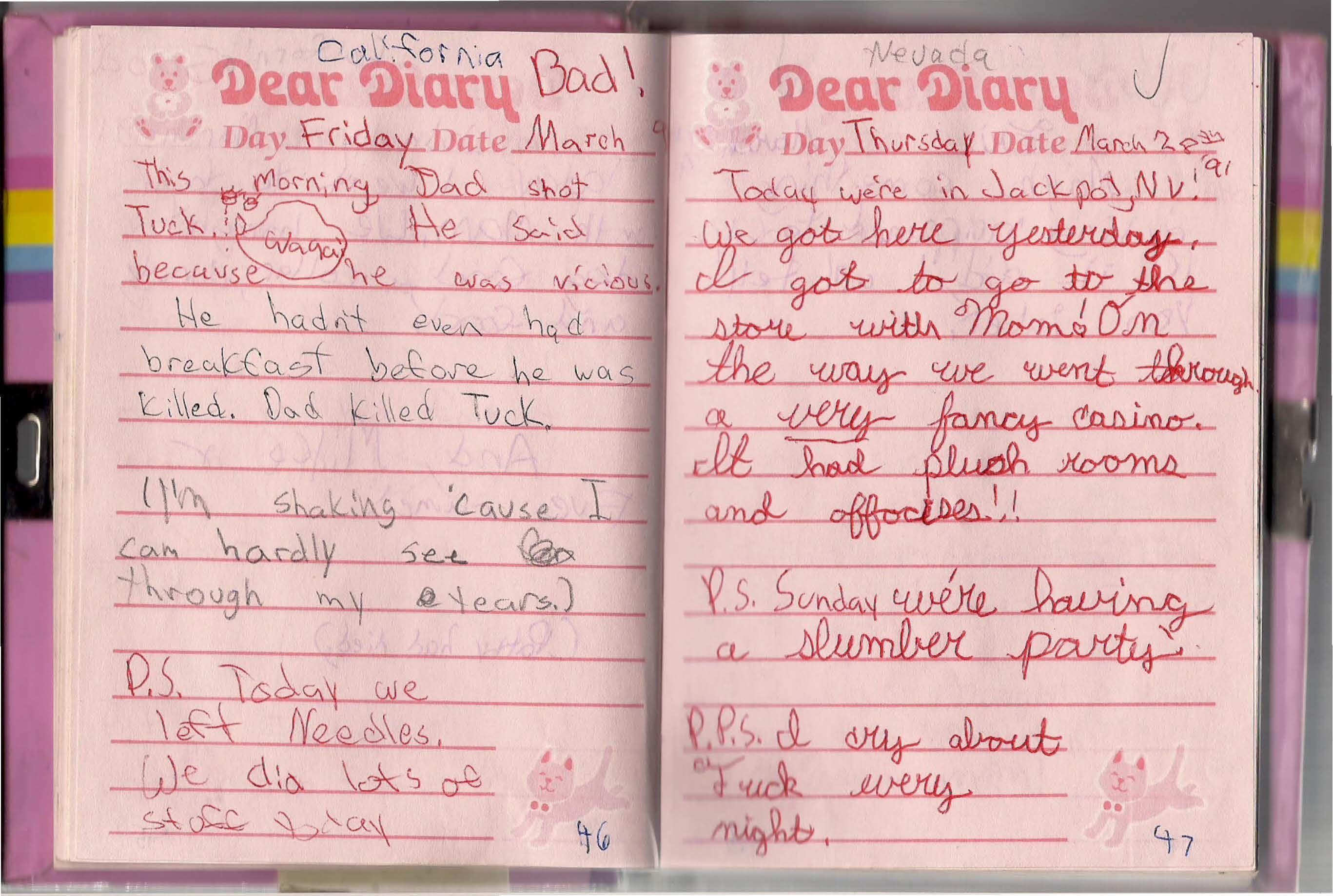
Once I fell asleep behind a creosote bush in a place I liked to visit to get away. The campsite was somewhere in the California desert, a place we knew and always stayed for a while when we were passing by. I could wedge myself between two bushes and the branches would sway over me, creating a perfect hiding spot. The sand was finely ground and soft as a pillow. Gradually I fell asleep. I woke to a sound. I kept my eyes shut tightly, feeling as if even the movement of opening them would draw attention. I heard soft padding in the sand, and then panting like a dog. I froze. It must be a coyote! I wasn’t scared of them, but they were unpredictable and what if it had rabies? The sound paused, as if the creature had sensed something. I opened my eyes as quietly as I could. Nothing. I slid slowly out from my hiding place, making no sounds. (Desert kids learn this skill). Nothing. The smooth sand held no trace of pawprints besides my own. A dog ghost, then.

The most recent dream I remember feeling like a premonition or a message was a few years ago, before I started living such a grounded “default” life, as burners term it. This life full of reality and 9 to 5 and boring people, stock happiness with everything I need and little I want. I try not to feel ungrateful, to tell myself this is what everyone wants. It’s hard to convince that little desert rat gypsy soul who lives inside me.

I was walking in the desert as the sun went down. The light reflected from cliffs with a warm golden glow, the shadows lengthening toward me. I stooped and picked up a few rocks, rolling them in my palm as I often do when hiking. I felt their roughness, watched the dust drift down from them. People say when you’re dreaming to look for details, to pick up a leaf and try to see its veins, to look at your hand and see if the lines are there. Dreams supposedly can’t hold this level of detail, and you will know you are dreaming. Every detail I looked for was there, this time.

I kept walking and over a rise spotted the ruins of a hogan among the boulders. It was the same color as the desert around it, and hard to see. When I walked down the hill and found the low-risen door on the other side, I bent and went inside. On a rock looking up at the hole in the roof was an old Native man, a feather in his hair. He work blue jeans and work boots and a barely-there mysterious smile.

“Look,” he said. “They’re everywhere.” He reached out his hand and stuck it through the solid rock wall of the ruin. His arm disappeared up to the elbow, then he was gone. I believed, in an instant, and stuck my head through the wall to follow him. I glimpsed a world of all grey with diffuse light and an empty plain before I started awake in wonder. I looked up the word the next morning. “Sipapu” is a Hopi or Navajo word for a small hole Pueblo people would build in the floor of their kivas, to symbolize the portal their ancestors entered this world through, from the destroyed underworld.

I told my mom this story, and she scoffed. She said we’d both read the word in a Tony Hillerman novel when I was a kid. I am still looking for sipapus.

sipapu

Roads on Her Face #24: Low-Rollers in Vegas

We used to roll in late at night, us kids pressed to the windows and staring at the beautiful lights, the Venus-fly-trap city surrounded by real life and the destitute.

I’d been to Vegas many times before I turned 21. I didn’t know the Vegas of the movies or the late-night sinners, though. I knew the Vegas of dark empty parking lots, seedy outskirts and Circus Circus.

It’s hard to describe the feeling I get disembarking from a plane in the airport there, with the omnipresent ching-ching-ching of the slots, the red-eyed smoking grannies tugging quilted bags full of lost hope, the weekend strippers in Juicy sweatpants and too much makeup. It’s a high, knowing I’ll have a story to tell when I leave, a bad-ass party weekend where I cut to the front of lines, floating around on youth and short skirts. But underneath that lies the knowledge that behind the shiny façade of the strip are the back-alleys off Fremont Street, and farther back in the city away from the tourist traps are the steak-house strip clubs open all night, where the fat old girls that can’t make money at the Spearmint Rhino play slots until 1 a.m.  and barely look up when the front door creaks open. Behind the knowledge of my present youth lies the knowledge that it won’t last much longer.

The homeless shelters are packed full here, and most of the bums sleep in deserted buildings or behind the truck stop. We used to roll in late at night, us kids pressed to the windows and staring at the beautiful lights, the Venus-fly-trap city surrounded by real life and the destitute. We would park in truck stops or far back in the dark parking lots of the old hotels and casinos, the ones that no longer paid a security guard to kick out anyone who wasn’t spending. When we came in with a nice trailer, maybe the Airstream and a presentable-looking van, they left us alone anyway because we might be retirees traveling the country and even now inside the too-cold casinos, preserving minutes of what was left of our lives with whiskey and video poker.

Dad would disappear when we got there, maybe for a day or only for several hours if his luck didn’t hold. Now I know you get free drinks sitting at a blackjack table, though then I didn’t even think about what he was doing. What money did he use? Was that our welfare check reduced to shiny chips on the plush green table? But we didn’t think about that, not then. We thought about how hot it was waiting in a van, how the day dragged by punctuated by flies or hopefully a walk to the gas station for something cold to drink. Mom never wanted to leave the trailer, knowing he could walk back out and want to leave in a second, pissed off and taking the anger out on her if she wasn’t ready to go. Furious if she wasn’t there to watch our shit.

But sometimes, sometimes he was lucky and he came out smelling of a good cigar with a wide grin on his tanned face. He’d have on his nice clothes and just-shined boots, and a wad of money in his pocket. He’d say “Come on kids, we’re staying here tonight,” and joy! That meant a room with real beds, a TV, a shower! We’d haunt the hallways of Circus Circus, the garish colors and clowns everywhere, giant lollipops the size of your head- how do you eat those anyway? I remember the motorcycle spinning in the cage, I was sure there was no way the daredevil would stay on it, no way he would be able to slow down. I remember the trapeze artists high above our heads, remember wondering if that flimsy little net would keep them from dying broken among the crowds of upturned faces. And in the morning we would leave early, before it was hot, the day dawning sullen and the future not as bright as the one we’d just left behind.

I went into Circus Circus a few years ago with a girlfriend. The carpet smelled of old milk and too many years of cigarettes to be a place meant for kids. And it never was, of course – like anything in Vegas, a trap. A place to lose your money and drink, smoke and whore – this one was just decorated with childlike things. Looking over the railing in the center arena where the circus performers were, I saw piles of cigarette butts, inches of dirt and popcorn and probably vomit. The paint was peeling, the cocktail waitresses wore masked smiles but their eyes were full of hell. It was Fear and Loathing, and all I wanted were drugs to make it bearable.

Roads on Her Face #22: Town Kids

There was a big difference between town kids and us. A gaping chasm, in fact, if you asked us. Town kids were afraid to get dirty. Us, we jumped in mud puddles with both bare feet. Town kids were soft, and ate too much candy. We were hard, with leather soles able to run through patches of goathead stickers with abandon. We ate beans and rice. Town kids sat lazy butts in front of the TV all day, while we roamed wild through the desert or forest or on lucky occasions, near the ocean. Town kids needed someone to entertain them, they lacked imagination. While we, when Dad said “Go amuse yourselves,” we had hours and days of complicated games and storylines – we were horses and cowboys, we built entire cities where certain trees and rocks were buildings (the jail, the store, our houses), we had clubs and threw parades and were the heads of armies. In the desert, we built swirling labyrinths delineated by stones and walked through them as if we could not see their outcomes without walls. We had friends in the trees and magical beings all around us.

Yes, I am the oldest, and much of the wild imagination came from the overload of books I’d consumed already. The other kids followed me because they had no other friends, and because my age and the fact I often had to watch them made me default leader. When they were older and off with their own crowds, other boys, I missed them though I might not have realized it at the time. My little sister doesn’t remember most of those wild free times, being the baby and not included in the complicated little hierarchy we had established in those road-days. She was 4 or 5 when we settled in New Mexico. I think she feels like she missed out, in a way, and maybe she did.

When we wanted to insult each other, we might call each other town kids, or maybe dweeb or dork, because those weren’t on the list of forbidden insults that might get a swipe from the belt around Dad’s waist. We came up with some of our own names, like “weed” or filthy little wretch, and those were worst and stung the most. We had fistfights, for a while, until we stopped. We shot each other with BB guns and stabbed each other accidentally with knives, and decided not to rat each other out to the grownups. Rowdy and I ganged up on Reno, and he and Rowdy ganged up on me. Sophie was the baby, the outcast that we didn’t want to have tag along. She turned out to be one of the coolest of us, though, tough and self-assured. She has us and the trickledown meanness of our clan to thank for that.

We didn’t speak about our parents much when we were off alone. It was unspoken that Dad was in charge, and that Mom got picked on the way Sophie did. When they fought, more often in the latter days, we merely made ourselves scarce and kept quiet, not wanting to draw any of the overflowing cauldron of ire our way. We protected each other from outsiders, knowing what it felt like to be broken from the herd and left alone to face strangers, the way antelope are picked by lions from the outskirts of their crowds of brethren.

The road and the way of life left lasting scars and opened minds (it calls me insistently, all the time). I like the person it made me, the inner toughness it left, the appreciation for everything it instilled. I hope my brothers remember it always, and I hope they’ve gained some of what I did from the experience. I thank my dad for that, if nothing else. He gave us a start in this life that most people never dream of.

I still think we’re better than the town kids.

Roads on Her Face #21: How School Happened

It’s more fun to tell stories than to talk about logistics, but the logistics of “how stuff happened” are always the parts people want to know more about. How did you eat? (Mostly with our mouths). Where did money come from? (It grew on trees). How did you get so smart? (I didn’t go to public school, much).

School the way most kids did school wasn’t really a viable option, given Dad’s penchant for pissing people off, landing in jail, or general anti-social tendencies. It’s hard to catch the bus when you’re 40 miles on a dirt road from the nearest bus stop. School officials tend to ask questions that no one is prepared to answer, such as “Where are your school records? Do you have an address or a phone number?” Somehow, we were accepted at many schools all across the country, mostly I imagine because we brought in extra cash to the district as low income little desk-occupiers. No one ever followed us when we left after a few weeks or a month, and I wonder if anyone ever noticed. I didn’t get too close to most of my school acquaintances, who were usually of the lonely outsider type anyway. They were just glad to have someone to sit with at lunch, and I was glad not to have to try to talk to a group of kids at once. I was much better one on one. I didn’t particularly want them to come over to play in our trailer or car, and I wouldn’t have known what to tell them when they started asking questions. I was savvy enough to know that I was vaguely ashamed of us, but also proud that we could make it living this way when I knew most of the people we met hadn’t the vaguest idea how we survived. I liked the idea of being self-sufficient, and still do, though now I realize how heavily we relied on government aid most of the time.

Now, I want a homestead off the grid somewhere in the hill country in Texas. I want chickens, and maybe mini-goats, an art studio, and a big spread that I can fence off and hide in. I’ll fit right in in Texas.

So, school- my mom’s daddy, Papa, had put some money aside in a savings account for me when I was born. Instead of having it for college, it got tapped into much earlier to enroll me into an expensive Christian satellite school program- well, expensive for homeless folks. I think it may have been between $200 – $500 for the whole school year, very cheap especially considering the quality of the education (even with all the Bible parables sprinkled in). I’m guessing some of the rest of that money went to food, and probably beer. We were able to get the student and teacher books, the tests, study guides, and lesson plans. I would do school in the morning and have the rest of the day off. When a dedicated kid sits down and completes all the schoolwork typical in a normal public school day, she should be done before noon. So much time is wasted in timekillers, recess, and babysitting that it’s no wonder kids are so under-educated. By the time I surpassed my mom’s math education, I was easily schooling myself and honestly grading my own work. The other kids were young enough that reading and some math and coloring were good enough, and by the time we settled in one spot and enrolled them in public school for the rest of their school years, they only had a few missing years of education and still easily tested into their respective grades. They went to a small New Mexico school that also needed more desk-warmers, and the accompanying grant money.

I went to two full years of public school my last two years of high school, where I got the requisite sexual and partying education every teenager needs. I didn’t even go to some of my classes and still got straight As. I helped the overloaded teachers by explaining geometry to a few of the other students, and they overlooked my occasional truancy and low-cut blouses. I got a full ride to college, too.

Roads on Her Face #20: Push Came to Shove

There are things I’m still pissed off about years and years after they happened. I wish I could let them go, but even if I laugh them off now they still hang on to the edges of my psyche. The school zone ticket I got after school hours, and the small-town asshole judge that talked with the offending officer about their upcoming fishing trip, after the “trial.” The fat woman who loudly asked what was wrong with my brother’s face, when he got out of the hospital after being wounded in Iraq. The old bag who threatened to call the police in a park somewhere in Idaho, who was sure the ragged little kids on the swing set had to be good-for-nothings.

You have to take a break now and then after hours on the road with kids, and public parks across the states are a quiet place to rest and let them out to run off some energy. Parking lots and rest areas do in a pinch, but green grass, shade, and jungle gyms do a lot to tame the wild beasts.

It was a cloudy day, almost chilly. We must have been headed south, skittering like leaves before a winter storm. We were trying to park overnight, so we had to keep a low profile and not look like we were planning to do what we were planning to do. The kitty was beside the car with her cotton rope leash tied to the side mirror. She lay quietly in the grass, being a smart kitty.

Mom was reading in the car, and Dad was listening to the radio. Sophie was sleeping quietly, and Reno was driving a Matchbox car through the Sahara-like dunes of the sandbox on one side of the playground. Rowdy and I were over by the swings. “Push me!” he called, swinging his legs and looking back at me. From out of nowhere a fat kid with cheeks like biscuits arrived on the scene. He made a beeline for my brother and announced “I wanna swing!” I looked around, and didn’t see any parents.

Shit! I hated confrontation, mostly, though I didn’t avoid or mind the shot of adrenaline that came when you knew you’d have to do something soon. The fatty was way bigger than Rowdy, who was staring up at him in blue-eyed shock. We weren’t used to people arriving on the scene. We didn’t have to talk to other people, and most of the time we weren’t supposed to.  Fatty unceremoniously shoved Rowdy off the swing. OK, time to do something.

I was a lot taller than fatty. You could tell he didn’t often talk to girls, mostly by the cheeks and the small piggy eyes. They glared at me out of his reddening face as I walked right up to him.

“Get away from my brother!” I said, picking Rowdy up and grabbing the swing. “We were here first, go play somewhere else.”

From behind me I heard the war-shriek of Grandma. “You get away from my grandson, I’m going to call the police!”

“Shut up, lady,” I said, the adrenaline showing up. I was talking back to a grownup I didn’t know, and that was a new feeling. I swallowed the lump in my throat and turned to face her. “You can’t do anything about it.” I wanted to tell her how her grandson was fat, and she should make him exercise. Also he was a bully, and that he needed to get his ass kicked. I wanted to tell her that neither she nor he nor anyone else had the right to push us around, but “Shut up” was going to have to do.

Her mouth hung open, and I could see the family resemblance clearly, though she probably hadn’t had as much food as this kid, being raised in the Depression. She hadn’t been spoiled, so she made sure her grandpiggy was. Also I decided it was time to get back, because she had said “police” and Dad would not have taken kindly to anything involving police. Us three little ragamuffins scurried quietly back to the car, flying under the parental radar. My heartbeat slowed, but I never forgot. It was easier to tell people to fuck off after that.

Roads on Her Face #19 : First-rate Forest Service

When you mention you’ve lived in Mammoth Lakes, California, people naturally assume you are a wealthy brat whose parents have a ski lodge in the mountains, built especially for escapes a few times a year from the sprawl of L.A. We didn’t live there in the winter, though, as we would head south to the blessedly warm desert before the first hints of snow. Living in a car limits your environment, seasonally.

I remember the sweet smell of pine sap and the soft needles underfoot that let you creep up on unsuspecting brothers, the glistening black carpenter ants that hurried up the superhighways of the ponderosas which seemed plain as lighted roadways to the ants, the highways that you could strain your eyes and imagine you too could see. I remember the hush and sighs of the forest, the caws of crows and the yammering blue jays, the tap-tap-tap of the brilliant woodpeckers. I remember how a short walk would take you into the woods, away from anyone. I would settle down beneath a tree and read or write in my journal, cushioned by bark or perched on lichened-softened rocks, I would revel in the protection of the forest. After empty deserts, I felt so protected, so hidden, between the trees.

We were living in the car, then, either sleeping in the back or the tent. It was dry that summer, so we didn’t bother packing everything up into the car each day. Just our food, to keep it from bears. We were out miles from the edge of Mammoth, tucked into a quiet pocket of the John Muir Wilderness of the Sierra Nevadas. Years later, I picked up a photograph of an eagle at a yard sale. John Muir’s signature is penciled across the back- I don’t know if it is a fake but I knew who he was because of his name on the wilderness signs.

Occasionally we would see rangers, but they left us alone. We weren’t littering, and we kept the campsite straightened up so it didn’t look like we’d been there for weeks. I think they felt sorry for us kids, and didn’t want to make things harder for us. They weren’t hard, though, that’s the part no one ever realized. We were happy being kids, and the forest was a playground made just for us.

My book supply was stocked by the bookmobile, driven by Miss Heidi and parked weekly not far from where we were camped, providing “forest service” to outlying homes and the occasional itinerants. She was warm and friendly, and loved books almost as much as I did. Right away she got me a library card, and handed me the first list for the summer reading program so I could get started.

“You’ll have to work to catch up to the other kids, they have a few weeks’ head start,” she said. “Do you want some help picking out books?” I shook my head, and in minutes had a stack that took Mom and me two trips to load into the car. We had library bags with the string top, so we had to hold the bags to our chests so the books didn’t break free from the cheap plastic material. I was back each week, with every single book in those bags on my “read” list, even the little kids’ books we picked out for the younger ones. I gave Heidi one-page book reports so she would know I’d read them. After the first week, the amazement on her face changed to a welcoming smile. She wrote me letters for years General Delivery or to P.O. Boxes in Nevada or Oregon or Arizona, telling me about her husband, sons, and her dog. Another touchstone, and a very grateful little girl.