
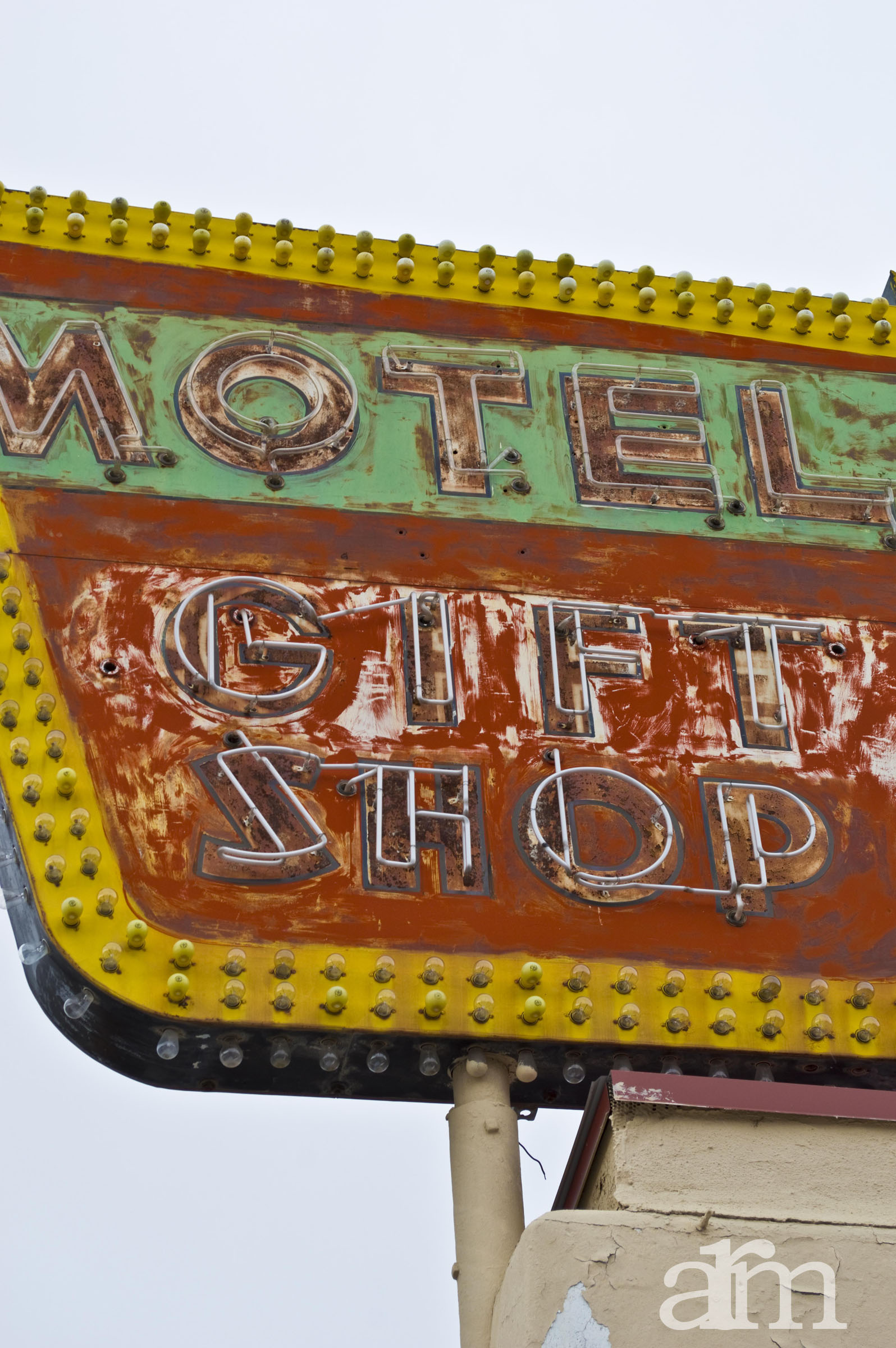
 More Northern New Mexico awesome. I love these colors, the composition, everything about this shot. I would have liked a little more light but it was snowing so…
Tag: travel
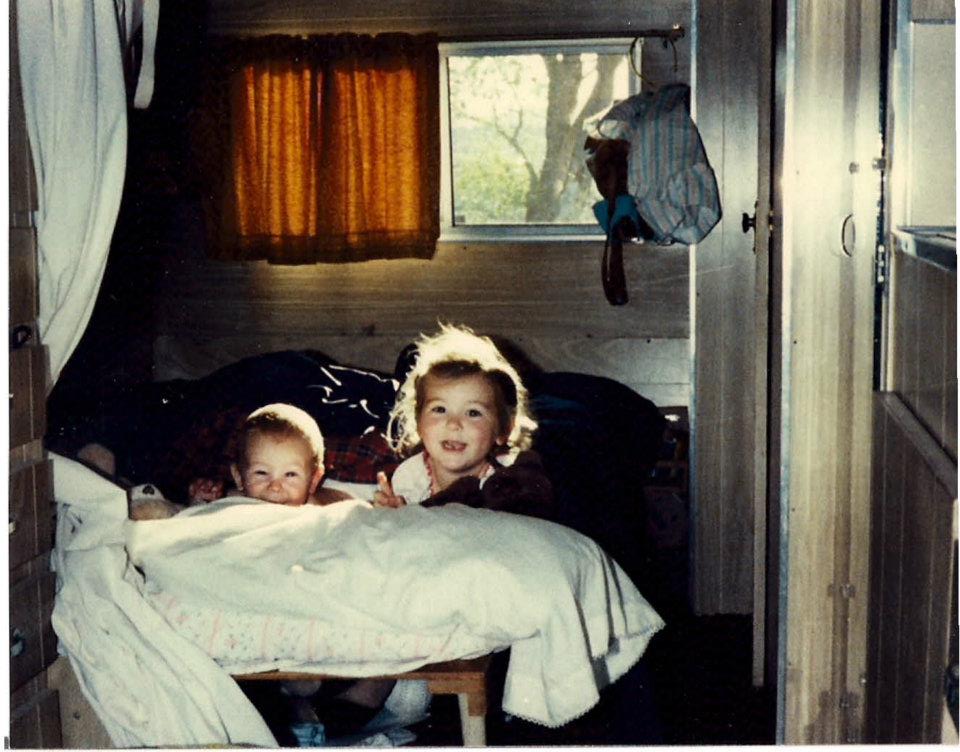
Rowdy and me. Somewhere in the desert, circa around 1988.
Day 6: Portraits

I hate posed photos of people, so try to avoid them at all costs. Bobcat is naturally photogenic.
Day 5: Unusual Subjects

This is a photographer’s dream spot- empty, strange things wherever you look, and lots of lighting challenges.
Roads on Her Face #28: And Then Came a Settling
An hour later and Dad was gone. And this time, he stayed gone. You never bring the cops into the picture, ok Mary? Didn’t you ever learn?
I started out thinking I would only write about my childhood, the interesting part of my life so far. Then I realized that wouldn’t be the whole truth. I am trying to tell the truth, and it’s easier to tell the far-away truth of your childhood than the truth that comes closer to your present life, the time when you should have no excuses and should “know better.” The whole gallivanting around the country thing stopped when I was 12, when we settled in a little New Mexican mountain town called Glenwood. It has its share of interesting characters, stories, and beauty, and I’d be remiss not to include them lovingly – and sometimes not so much – in this accounting.
We weren’t going to settle. We had never settled before. It shouldn’t have been any different than the thousand other times we’d stayed somewhere for a while. Except that this time it was.
When you roll down the hill on 180 into the little green valley around Whitewater Creek and the Gila River, you pass a tiny campground on your right just a second before you roll right on through town in approximately 3 minutes, 2 if you’re speeding. I don’t recommend speeding, because there’s always a local cop who doesn’t have anything better to do waiting just after the bridge over the creek. You’re welcome. Big Horn Campground has maybe 10 spaces crammed into a parking-lot-size area near the wash that splits the parkland from private property. The private property across the creek is owned by one of the couple of families that own Glenwood, and have for many years. Likely since their ancestors settled here and homesteaded, but I never cared enough to do the research. They’ll make sure you know they’ve been here forever, goshdangit, so don’t you worry about how long exactly.
Like most Forest Service campgrounds, you could stay in this one for free. Though most people would stay for the weekend, we were definitely going to take advantage of the two weeks. And we did, plus maybe three weeks, until a nice ranger told us it was about time we moved on. I think Mom was struggling to put some roots down quickly. She had always loved this little town, and so had Dad. They’d dreamed and talked about staying here through the years, so close to where she’d picked him up hitchhiking in her little yellow Bug. She probably knew by then that those were just dreams, that she’d tied her life to a man that could never settle down and didn’t know much about roots.
The old patriarch of the family in town- I’ll call them the Luthers, and him Coy, just in case they’re out there Googling around (I used an online List of Redneck Names to name these people from my recent past, I hope they will forgive me)- had watched my mom come in to the general store/gas station that he owned with us kids for a while. Coy had watched Dad, too, I’m sure, stumbling back up the campground after drinking at the bar Coy owned. He probably sat in his house next to the old hotel that he owned, too, and thought about what he could do to help her out. That pretty little blonde thing with all them kids and a drunk-ass husband. Mom’s always been good at getting help without looking for it. I don’t know if she was asking around for a job, but in no time at all she had one bookkeeping for Coy and we had moved the trailer onto the private property just on the other side of the wash from the campground. We had electric hook-ups and running water! It was a goddamn windfall. Knowing that little town as well as I do now, I can just imagine the rumors and hearsay spreading scarlet-letter style through the grapevine, which had tendrils pushed into every house in a 10-mile radius. It didn’t come back to our insulated little family, and we kids were happily oblivious. What we knew was that we had a nice quiet place with water. We had lights that worked, and Dad set up an outdoor shower. We had met some kids that lived on the other half of the land, in a house butted up against the hill that separated our little haven from the rest of town. Cole, Coy’s son, and his wife Lynne lived there with their three kids. Mom was even talking about enrolling us in school. Then Dad started drinking harder, and a pall hung over all of us. We could see the dark clouds gathering, and inside I resigned myself to moving on again soon. I hadn’t seen the hard light glittering in Mom’s eyes, though, or counted on the set of her jaw.
He was sitting in a camp chair behind the trailer, and the sun had just dropped behind the hill. Long shadows touched my feet. Mom was cooking dinner inside. He stood up and stomped on a beer can, the sound one I hear often when I think of him. Stomp, crush, stomp, crush. He hacked a loogie, another sound I hear because my brother takes after him.
Slightly off-balance, he pulled himself up the trailer steps and joined Mom in the kitchen. I didn’t go inside, but I could tell she wouldn’t be looking at him.
“Tomorrow, we need to pack all this shit up and get out of here,” he said. “It’s time to head back toward Arizona.” She didn’t say anything for a minute.
“I think this is a good place to stay for a while, don’t you? The kids like it here,” she said, quietly.
“We do what I say,” he said, his voice rising. “I don’t think I asked you what you thought.” The trailer rocked with the building anger.
It took about 15 minutes for the screaming and shouting to start. Five minutes after that Mom was rushing outside and grabbing my arm.
“Listen to me, ok?” Her blue eyes were rimmed in red, the pressure of all those unshed tears. “I need you to run down to Cole and Lynne’s house and ask her to call the police, ok?” I nodded and took off, the way I always did when she asked me to run. All the running practice made a difference at times like this.
An hour later and Dad was gone. And this time, he stayed gone. You never bring the cops into the picture, ok Mary? Didn’t you ever learn?
Journal Entry- August 28th, 2011 Fallon, NV
Describing the drive across the Nevada emptiness – something you feel more than think. The comparative busyness of Arizona with its big highways and changeable scenery starts to fade east of Vegas. The bones of the land rise stealthily, underground stone serpents slithering just out of reach of your notice. The shadows become more blue, the sage and scrub brush more pervasive. There are no more trees, as if their entire race was obliterated here. Wait, no, a lonely pair of young cottonwoods have been planted as the wilting guards on either side of the burnt gash of a road leading to the blood-reds and pus-yellows of yet another strip mine. The earth bleeds and cries freely here and there is nothing and no one to comfort her. When there is an end-time, it will mirror this and we can say we saw the portents. Clouds stay high above the flatland, streaming down from a mile overhead, sometimes the rain reaches the ground to be blown violently across the road and fill the washes. The old-timer at the Hard Luck Store in Mina called these “gullywashers.” “We don’t want it to rain too much, not now,” he responded to my “But isn’t this nice?” His bleary blue eyes rolled over me to glare out at the thin freshly-washed strip of blacktop.
The smell of the rain is the smell of the dusty breath of the sagebrush, held for months in anticipation of this brief half-assed blessing. The colors and the light are like nowhere else. It’s as if, in death, the land deserves this heavenly illumination. As if the sky feels sorry for the stones it exposed, and drenches them in forgiving saturated color. If there is a place for the hills to have eyes, it is here. You can feel them on you all the time. You just hope the engine keeps running, and the air conditioner doesn’t give up.
4 p.m.
We just got invited to a shotgun wedding in the park. She’s about 9 months along, 16 or 17 at the most. I say hell yeah!
Roads on Her Face #27: Nevada’s Not for Pussies

There are two memories tied inextricably together in my mind, by tenuous flashing synapses deep within my cerebral cortex somewhere. I never think of one without the other, though I don’t know if they were chronologically close. It doesn’t matter, because the place the past lives is in our memory among the grey matter. There is no time besides now.
Elko is a little town hidden between the bare rocky breasts of the Ruby Mountains, way up Interstate 80 before you cross the flat white plains of the Great Salt Lake, if you’re traveling East. There’s a casino, because it’s Nevada, and some hard mountain people who may or may not be currently running from the law.
Dad got a job there as a tow truck driver, and we lived in our trailer on the tow lot just off the main drag through town. I don’t know how long we lived in Elko; it felt like forever and no time at all. Eventually, Dad would have pissed off whoever hired him and we hit the road, not looking back. While we were there, it felt like a precious gift that could be snatched away in a second. The mountains were brutal, to drivers who didn’t know them, and they killed with abandon, shaking cars off their ridges and becoming so black at night that people would just drive right off the interstate. The tow truck was busy, and the bounty that came with the cars towed in from the dark felt like the dreams I have now where I am shopping for hours, picking up treasure after treasure and loading myself down. I’m sad when I wake up, all that work and searching for nothing, for these empty arms. When people wreck, the detritus of their lives floats in a sea of sad, and they never come back for it. They don’t want the memories that seeing their car and the things they were traveling with would bring. We would find suitcases full of clothing, money under the seats, purses splashed with blood. Toys children had dropped as the car spun in slow circles before the terrible finality of impact. I would sit in cars smelling of their occupants’ perfume and stare at the starred windshield in front of me, imagine the blonde head that struck the glass and left two hairs. I would feel the car crumple, hear the shrieking of metal and smell burning rubber. I would be careful not to touch the bloodstains when they were present. A few times I asked Dad if the people had died, but mostly I didn’t want to know. I was happy to keep their things, and I didn’t feel a shred of moral ambiguity. We had learned right off the bat not to question gifts from the sky. When much of your time is spent on the road, you find things that have fallen from vehicles with exciting regularity. If we spied something that looked interesting, Dad would say “Hang on! Put your seatbelts on!” and swerve off at the next wide shoulder so he could jump out and run back to retrieve it. Sometimes it turned out to be trash. Other times it was a box from FedEx, or a wallet. We found a duffel bag once, with clothing and toothpaste, shoes and money. I carried with me an image of someone’s trip turning shitty when they arrived at their destination and realized they had nothing, and I wished I could give their things back to them.
Elko was quiet, and possessed the kind of communal geniality peculiar to many small towns. If you left people alone, they left you alone. I’m sure they talked about us, the travelers living at the junkyard. But we didn’t stand out in towns like that. There were others like us, traveling the back roads and staying until their time was up. Some of the wayward would settle in places like this, away from the big cities and welcoming the quiet accommodation, welcoming being left alone. Either you assimilated or you did not, and the town went on about its business.
Like most former gold-rush towns, Elko has little festivals and whatever they can throw together that might bring in tourists. There’s not much to do out there for work, unless you’re a hooker or a miner. I was reading in the trailer when Mom came in and grabbed my hand. “Come on, honey, they’re having a race! You need to run in the race!”
“But, Mom, I have my boots on!” I said, confused, startled, staring at my black cowboy boots as I was hustled across the street to where a festival was going on. Sure enough, there was the race line and there was a small crowd watching. Dad was standing there, looking back for me expectantly. I couldn’t have been more than 5 or 6, because I only remember Rowdy then. Reno had to have been a baby, or hadn’t come along yet.
It had to have been Dad who sent Mom to get me. He had this image of me growing up to be a runner, and he would send me out to run laps around creosote bush courses that we mapped out beforehand. I would go and go, never getting tired. I was a fast little shit, too, until I got lazy and stopped running, preferring only to read somewhere as far away from my family as I could get. These days, I run because I like it and people think I’m crazy. Maybe Dad had something right.
Mom pushed me into the line of other kids. All of them towered over me. I was the littlest one out there. And I had on boots! I couldn’t run on cement with these boots on!
But BANG went the gun, and off we went. All I could see was the chalk finish line and a blur as I focused in front of me. I ran as fast as I could run, faster than I had ever run. My boots flew, I barely touched the ground. And then I was there, and I turned around. The only one there! The other kids were far behind me. I heard cheers, and a man handed me a silver dollar. “You win, girl,” he smiled at me. “Speed racer.”
The other memory is of swim class. Mom has always been a good swimmer, easily swimming laps with her strong little body moving like a seal. She wanted us to be, too, but we were rarely near water. I have always been the edge-swimmer, holding on to the side after dog-paddling for four breathless strokes.
I think we were in Fallon. Nevada again. We weren’t there long, because I only got to go to a few classes. Rowdy was there, too. Mom would drop us off for an hour at the pool, and two brave women would try to teach a group of little kids how to swim. I was on a kickboard, kicking along, and then I wasn’t. I stopped moving completely as I sank slowly to the bottom. Looking up, the light filtered through the water like blue stained glass, twinkling warmly. I didn’t know why I wasn’t trying to swim. It was so peaceful under there, so quiet with the sounds of the other swimmers dulled to whispers. I had held my breath, and wasn’t choking, so when strong arms reached down and pulled me away from the quiet I was angry. The woman threw me out of the water and another grabbed me, pounding my back. My breath was gone, so I couldn’t yell at them that I was fine, I was fine, there wasn’t any water in my lungs! I wished I was back there, back at the quiet bottom.
Roads on Her Face #26: Animal Instincts
As I listen to my mom pull her story out of herself piece by piece, matter-of-factly but as if it were a struggle, realizations come to me unbidden. She talks about the people my parents would stay with, here and there, everywhere, and for the first time I think that maybe those people didn’t look forward to these visits. For the first time I see my dad as a mooch, as not so self-sufficient, as not so strong. I think about those kind people who helped, and maybe grew tired of helping, and I feel ashamed.
As a kid I thought of our visits to family and friends with excitement, and never thought that we might not be welcome. I never considered that we might need them, that his drinking had left us nothing and that we needed charity or a safe place to rest. We are so oblivious, in our little insulated child-worlds, even when we have seen the straight of things, the ugly, the dirt swept beneath the couch.
My own sense of strength and personal ability, even in the face of the ugly, comes from the deep feeling of self-sufficiency our little family instilled in each of us, whatever false basis it may have had. When you look closely, we were not alone. We were supported by welfare and food stamps, generous churches or “friends,” family who didn’t want to see my parents together but were swayed by the sweet (and dirty) faces of children. My dad could wheel and deal and spin nothing into cash, old cars into new trailers, empty pockets into dinner. We could live in the desert for weeks with no interaction with the outside. But we had crutches too, and I just now am wondering if I am too self-assured with too little reason.
What option was there, really? The road is no place for weaklings. If your skin is not thick enough the judgment of others will hurt. If you cry, they will pounce and devour you. If you put yourself in a situation, you might deserve what comes to you. You must be prepared for every aspect of the human condition, the animal condition too. Killers and thieves walk among us, and the herd must stay close and circle, ever watchful, around the young ones in the center.
Don’t talk to people you don’t know.
Don’t tell anyone anything, ever. Keep your mouth shut.
Don’t believe what they tell you. They’re out to get you, every one of them.
Cops and the government are ripping us off!!
If they ask you questions at school, don’t answer them.
Stay put, don’t whimper, little foxes. The den is the only safe place.
Roads on Her Face #24: Low-Rollers in Vegas
We used to roll in late at night, us kids pressed to the windows and staring at the beautiful lights, the Venus-fly-trap city surrounded by real life and the destitute.

I’d been to Vegas many times before I turned 21. I didn’t know the Vegas of the movies or the late-night sinners, though. I knew the Vegas of dark empty parking lots, seedy outskirts and Circus Circus.
It’s hard to describe the feeling I get disembarking from a plane in the airport there, with the omnipresent ching-ching-ching of the slots, the red-eyed smoking grannies tugging quilted bags full of lost hope, the weekend strippers in Juicy sweatpants and too much makeup. It’s a high, knowing I’ll have a story to tell when I leave, a bad-ass party weekend where I cut to the front of lines, floating around on youth and short skirts. But underneath that lies the knowledge that behind the shiny façade of the strip are the back-alleys off Fremont Street, and farther back in the city away from the tourist traps are the steak-house strip clubs open all night, where the fat old girls that can’t make money at the Spearmint Rhino play slots until 1 a.m. and barely look up when the front door creaks open. Behind the knowledge of my present youth lies the knowledge that it won’t last much longer.
The homeless shelters are packed full here, and most of the bums sleep in deserted buildings or behind the truck stop. We used to roll in late at night, us kids pressed to the windows and staring at the beautiful lights, the Venus-fly-trap city surrounded by real life and the destitute. We would park in truck stops or far back in the dark parking lots of the old hotels and casinos, the ones that no longer paid a security guard to kick out anyone who wasn’t spending. When we came in with a nice trailer, maybe the Airstream and a presentable-looking van, they left us alone anyway because we might be retirees traveling the country and even now inside the too-cold casinos, preserving minutes of what was left of our lives with whiskey and video poker.
Dad would disappear when we got there, maybe for a day or only for several hours if his luck didn’t hold. Now I know you get free drinks sitting at a blackjack table, though then I didn’t even think about what he was doing. What money did he use? Was that our welfare check reduced to shiny chips on the plush green table? But we didn’t think about that, not then. We thought about how hot it was waiting in a van, how the day dragged by punctuated by flies or hopefully a walk to the gas station for something cold to drink. Mom never wanted to leave the trailer, knowing he could walk back out and want to leave in a second, pissed off and taking the anger out on her if she wasn’t ready to go. Furious if she wasn’t there to watch our shit.
But sometimes, sometimes he was lucky and he came out smelling of a good cigar with a wide grin on his tanned face. He’d have on his nice clothes and just-shined boots, and a wad of money in his pocket. He’d say “Come on kids, we’re staying here tonight,” and joy! That meant a room with real beds, a TV, a shower! We’d haunt the hallways of Circus Circus, the garish colors and clowns everywhere, giant lollipops the size of your head- how do you eat those anyway? I remember the motorcycle spinning in the cage, I was sure there was no way the daredevil would stay on it, no way he would be able to slow down. I remember the trapeze artists high above our heads, remember wondering if that flimsy little net would keep them from dying broken among the crowds of upturned faces. And in the morning we would leave early, before it was hot, the day dawning sullen and the future not as bright as the one we’d just left behind.
I went into Circus Circus a few years ago with a girlfriend. The carpet smelled of old milk and too many years of cigarettes to be a place meant for kids. And it never was, of course – like anything in Vegas, a trap. A place to lose your money and drink, smoke and whore – this one was just decorated with childlike things. Looking over the railing in the center arena where the circus performers were, I saw piles of cigarette butts, inches of dirt and popcorn and probably vomit. The paint was peeling, the cocktail waitresses wore masked smiles but their eyes were full of hell. It was Fear and Loathing, and all I wanted were drugs to make it bearable.
Some Roads Come to an End

Pleasanton, New Mexico
 Roads on Her Face