
Roads on Her Face #12: Rowly’s Hurt!

Karl’s mobile home had a peculiar odor, of damp carpets scented with week-old macaroni and cheese, partially caused by the swamp cooler exhaling dank breaths into his dark trailer and partially caused by actual macaroni and cheese. It was an older trailer, with deep shag carpets made especially for smell retention. Whoever had it before Karl had been a smoker and the yellowed drapes and wood paneling both smelled of the ghost of smoke. But Karl had a shower, so Mom made it a point to be friends with him. I have a feeling he couldn’t believe his luck. We’d left Dad next to a smoking campfire somewhere in northern Arizona, with his SKS rifle and a bag of clothes. He’d told us to go ahead and leave him, get the fuck out. So we had. It was the first time we had really left him for longer than a day or two.

Already I was feeling the faint sense of escape, of hope. Mom had called Granny and told her we’d finally left Ed, and Granny was so relieved she loaned her the money to buy a trailer. A retired Canadian couple who were done with the open road sadly sold Mom their Airstream for $6,000. They were happy to be giving us a home, but they had cared for their trailer well and you could tell they had filled it with love. The man had cut little desert shapes from pieces of plywood and used it to decorate the overhead bins, the Airstream bins built like the ones over your seat in an airplane. The cactus was a little off, and the coyote was out of proportion, but he had spent time on his artwork and we never took them down. When the check came in the mail, Mom let each of us hold it. We looked at all the zeros after the dollar sign and held the paper reverently, knowing we would never see such a sight again.

In less than a month, Mom had gotten us a home, moved us into a trailer park in Needles, California, and enrolled Rowdy and me in public school. She stayed home with the two little ones, but she was looking for a job to augment the government support. We had lived in a car for long enough, with all six of us, and the freedom of the space in the trailer to stretch out at night, the electricity that gave us fans to use in the heat, all of it was almost too much. I was afraid to enjoy it, afraid every minute that it would all be snatched away and Dad would be back and sell it all and take us into the middle of nowhere again. I developed a Dad-crush on my 6th grade teacher, in the school that I could walk to from where we lived. We lived somewhere! I was going to school! At that age all I wanted was to be normal, to have friends, to stay in one place long enough to finish a whole grade. I knew we were not normal, and then there was everyone else. People with homes, and normal families, and parents with jobs, and kids with their own rooms. That was my biggest dream, a room where I could close the door and not have to smell my brothers’ farts and where I could hang my drawings on the wall. Where I might have a quiet place to read, and to write.

My homeroom teacher, Mr. Kincaid, was so kind, and he talked to us like we were human instead of bugs bothering him, the way conversations with Dad had gotten to be. Dad must have been itching to get away from us, the responsibility and the daily nagging concerns of this big family in this small space crumbling his self-control. It showed in his snappishness, his anger, his escalating drinking. He was accusing Mom of wanting to cheat on him, of wanting other guys, of looking at other people, though she was always with us and he was the one who came home late from the bar or never came home at all, showing up in the morning with red lipstick stains on his collar and laughing when Mom asked him about it.

Mr. Kincaid was smiley, and had a short well-groomed dark beard. He looked like a kind of man I didn’t know, a new kind of man and it was a revelation to see how he treated people. All men were not mean. It didn’t have to not be manly to be kind. Until then I had taken for granted that men were gruff, and hard, and stern, and men did what they wanted when they wanted and didn’t take no shit from nobody. Mr. Kincaid seemed like he might take some shit, and then he might sit you down to talk about it instead of beating your ass with a leather belt. I wasn’t sure that this would work with boys, who everyone knew could get out of control, but I thought it was a novel approach and might work with girls.

I made a friend, too, a strange gawky girl named Annie who was a Mormon and who lived in the trailer park next to ours. They lived in a nice trailer, one that was mounted to the ground and had a patio outside and that didn’t even look like a trailer. It could have been a house. Plus, she had her own room.

All I knew about Mormons was that they had a weird religion, and that there were a lot of them in Utah. I knew they hired retarded people, because we would go through Salt Lake City sometimes and all the stores had people working in them with Down’s syndrome or crippled legs. I knew they were nice, because they gave Dad a job last time we had gone through, and then they let us go into their huge store filled with food and new clothes and we got to pick what we wanted. There were big semi transport trailers outside that said “Deseret Industries” which I thought was fitting. We were from the desert, and they were helping us to start a new life, they said. I think Dad lasted a week there, and my hopes for that new life faded, the way I was used to hope fading. Quick, as if it had never been.

Karl was a strange bird. He might have been in love with Mom, too. I hadn’t noticed how many men loved Mom until Dan in Oregon. Dan had loved Mom so much Theresa and him had broken up. I thought it was strange. I had not paid much attention to the relationship between men and women, knowing I was not attractive and that it would be years before I had to worry about it. I read enough adult literature to know about it secondhand, and had no wish to complicate my life prematurely. But my mother’s attractiveness had escaped my notice. I saw a tired woman who wore no makeup and had worn thrift store clothes like the rest of us. I didn’t see the blonde, birdlike beauty who gave off the scent of “needing protection” though she had powered through life and come out stronger than most of the men who loved her.

One day Rowdy was riding his new-ish bike one-handed, a paper airplane tied on a string trailing next to him in the hot breeze of Needles. He was prone to focus on things to the point of forgetting everything else, even simple things like “Look where you’re going.” He looked up just in time to watch himself crash over the handlebars into a wooden post, the ones that told you what number your space was in the trailer park.

“Rowly!! Rowly! Mary, come quick Rowly is hurt!” We heard Karl howling outside, and Mom rushed out to find her oldest son with blood gushing down the side of his face. It wasn’t the first time, but it might have been the worst. Karl held his soft hands to the sides of his head, shaking it like a befuddled dog. His long hair and beard were tangled, because he didn’t have a woman to tell him to brush it. Mom could have told him, but that might have been too much like a relationship.

Rowly eventually stopped bleeding, and we didn’t go to the hospital because that cost too much money. Rowdy still remembers this, and will tell the story occasionally. “Mom, remember Rowly’s Hurt?” he will ask. And we will all laugh, and nod, and we will all say “Rowly.”
Roads on Her Face #9- Dan, Dan

Crazy George lived in a van, moving around from campground to campground. He was an old grizzled drunk, like my dad, so they didn’t get along. They would, however, drink together, because a drunk never likes to be the only one. Dad had an old beat-up chessboard that folded in on itself, each of the pieces glued to a magnet so they stuck to the board when the games were played in parking lots, or bars. He and George would stare at the board for hours, sitting on folding chairs around a small camp table. Someone would move a piece, both would drink. Someone wouldn’t move a piece, and both would drink. Mom was probably off scrubbing toilets or collecting money from campers. Sometimes some of us kids would stand around and watch, but we grew bored quickly and would wander off into the forest or down to the river.

Dan and Theresa also lived in a van. They stayed for a while at one of the campgrounds my parents were managing in Clackamas, that magical summer from which each memory is imprinted on my mind the way a flash from a camera imprints briefly on your vision, after you’ve closed your eyes. I am sure they got a special deal, because Dan liked to drink too and he would bring beer by, and Theresa. She had a great big long-haired dog named Woofus, who would sit down behind you and groom you on command, his teeth rubbing against you in little nibbles like fishbites. It tickled, and we would laugh and squirm while he did it. I had never seen mom with a friend before, a friend who was a real girlfriend and not just the wife of one of my dad’s “associates.” They laughed, and laughed, and laughed until they rolled on the ground. They drank beer together, and hid behind trees whispering about boys. I crowded them, wanting to be a friend too. They always let me hang out, never getting annoyed. I liked this mom, one who wasn’t cowed and tired and who acted like a 12-year-old girl. Like me. We set up a dome tent behind the trailer, and we had girls’ campouts where we could watch the campfire die down through the thin grey screen of the tent’s door. Theresa gave me a journal, which she inscribed with her name and the date in a loopy, flowing script. Theresa Sheffield, June 1994. “Don’t stop writing,” she said. “You are going to be famous one of these days.” At that point, I might have believed her. I searched for her years later, finding maybe 10 women of the same name who were still in the area. I called them all, but no one knew the slight blonde who had been called T-Bird in high school, who had a penchant for loser men, who had a dog who thought everyone needed to be cleaner. I wanted my mom’s friend back. I wanted her to have a friend from then, from when we were still a family and when adventure was the only way we knew how to live. I wanted to see if she had changed. I wanted to capture that summer and never let it go.

One night Dan got wasted around our campfire and decided he wanted to pierce his nose. I went to bed, and the next morning he was sitting at our wooden picnic table holding his face.

“What did you do, Dan? What’s wrong?” I thought he had a hangover. He did, but it was worse than that.

Mom’s lips were stretched tight across her teeth, her mouth a thin straight line. She might have been trying not to laugh. Dad was somewhere, taking a walk in the woods or having his quiet time alone. He needed space, especially after a bender of a night. We always welcomed the reprieve, our shoulders floating upward as some hidden weight was taken away.

Mom gently pried Dan’s fingers apart and exposed his nose, his big beak-like nose. He had somehow jammed a large safety pin right through the center of theseptum. She barely brushed against it and he cried out in pain, tears springing to his eyes. The whole area was a furious red.

“What in the heck did you do that for?” Mom asked him, pushing his hands away from his face again, as they had sprung back up in a protective gesture. She grinned over his bald head at me, then looked down again with nothing but concern on her face. Dan was in love with Mom, and everybody knew it. “Where’s Theresa?”

“Sleeping,” he moaned. “Please, get it out, please just take it out.”

Mom cleaned it with alcohol and yanked it out in one smooth move. Dan’s yell echoed through the valley. He disappeared quickly, into the tent behind our trailer. Bearlike retching sounds came from behind the vinyl walls all day, punctuated with “Fuck you, get outta here! Leave me alone!”  Every now and then the zipper would open and his head would pop out, spewing the clam chowder he’d had for dinner last night.

We had a chant, after that, “Dan, Dan, the drinking man, he lives in a van. He whips up chowder as fast as he can, and his nose is as big as a beer can!” We ran around laughing hysterically, rolling our eyes and punching each other to punctuate the singsong chant.

Dan didn’t like it, at all, and we had to whisper it when he was around.

After a few months, Dan and Theresa went their separate ways, Dan off in his van and Theresa back to her family. Their short relationship didn’t hold up after Dan fell in love with Mom. She said he needed a mommy. After they left the summer had a strange feel, as if it were curling up and browning at its edges, as if it or we had crossed a threshold. A few weeks later the clouds rolled in, and the days grew darker. Things began to mold, and slugs crawled out of their holes to leave slime trails like silken threads over everything. We were stuck in the trailer together, the musty smell of us overwhelming. Not many campers showed up.

On one increasingly rare sunny day, Dad drove us in the van to George’s camping spot. He was sloppy drunk when we got there, and it somehow quickly degraded into a shouting match. “I’m going to kill you you motherfucker!!” We heard George screaming, and then Dad got into the van with his set and joyous face, the way he looked right before there was trouble. “Come get me, prick,” he said calmly out the window, and then he drove us back to our campground. George waved a big machete at us as we left him at his van.

The rest of the day we waited breathlessly for the blood. George was coming to kill Dad! What would we do? Was someone going to die? It’s all we could talk about out of the earshot of the grownups.

Crazy George had a knife! But Dad had a gun. We thought we knew who would win. A few days later, with no George appearing, we packed up and headed south to escape the rains.

– Edited July 23rd after using some helpful memories shared by my younger siblings.

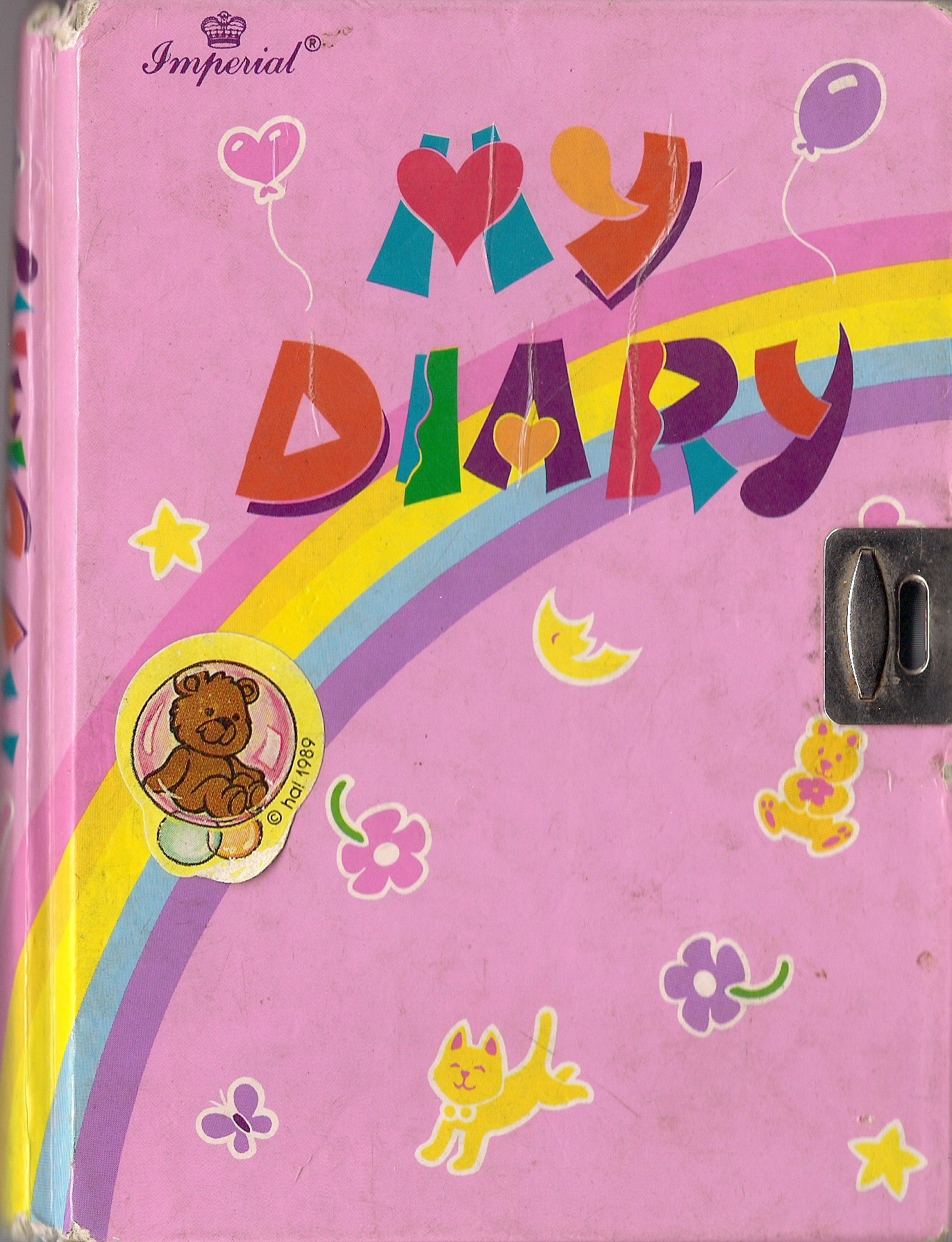
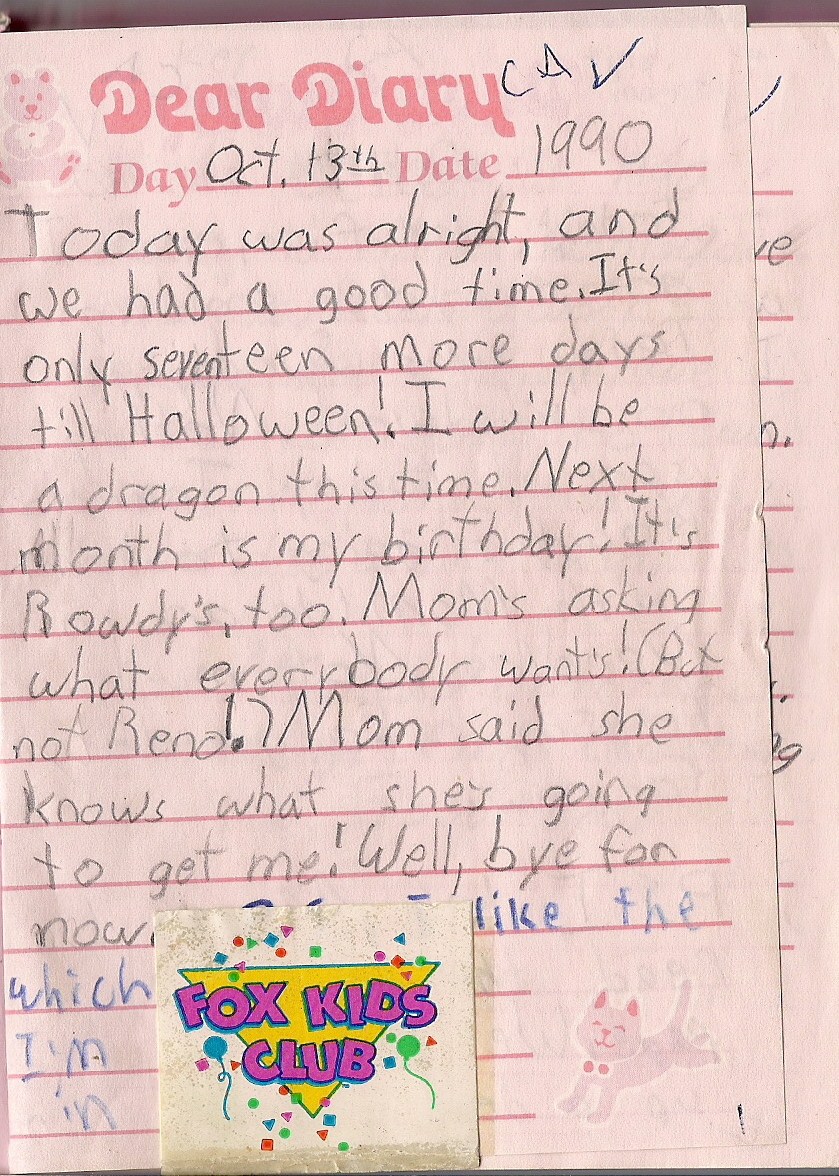
Images from the Road – First Diary

I know my family would get a kick out of this, I try to remember the mindset at that age and it’s hard. I think I suffered from the same thing I do now- it’s hard to share what I’m really thinking. Or I always thought of myself as more mature than I actually was…

I’m considering posting some pictures from those years on the road- would those take away or add to the story? I’m not sure yet.

Roads on Her Face #8: The DTs

I was reading, as usual, lost somewhere in stories of dragons and princesses who were cared for by handsome princes, whose lives were filled with mystery and drama and excitement. Our camp was set up in one of the busier parts of the Quartzsite desert, out behind the Main Event swapmeet where the less anti-social desert rats parked so they could walk in to trade and bullshit with the vendors. We were anti-social, but Mom needed to walk to work.

This time we were in a station wagon, our last trailer disappearing in some trade because Dad needed cash. I was 8, an age I remember clearly because it was the year I had my first job where someone gave me money and not promises. I’d had the unpaid job of helping  mom with the other kids from the time each was born, though they’d argue that if you asked them. Babies don’t remember who changed their diapers, or dressed them, or spent their time preventing them from swallowing crayons. And they are never grateful.

My job consisted of shoveling horse crap behind the stagecoach that tourists paid to ride around the swapmeet, like in the real Old West. The driver, Ron, was a drunk, with a big red nose and a dirty black cowboy hat. He only tolerated me at first, but gradually grew to trust me and even let me drive the horses sometimes when they weren’t acting up. They got tired of standing all day in the sun, sometimes, and once the stagecoach ran away with customers inside and me sitting on the top clutching the railing and praying that the top-heavy thing didn’t pitch over and kill us all. I liked working for Ron, being close to the horses I’d always loved from the stories I read, like Black Beauty. I liked settling the pale tourists inside and closing the latch on the door after them, then hopping up on top of the coach and watching the dusty town from a vantage point above all the cheap Chinese toys and ugly southwestern potteries, above the tables creaking with the weight of rocks and the rusted tools that were still worth money because they were Snap-Ons. I liked wearing cowboy boots and the leather hair cuff with a horseshoe nail through the center that the leather vendor gave me, that he said was free as long as I told everyone where they could get them. Lots of vendors knew me, as they watched us circle lazily all day around the packed dirt roads, clop, clop, clop. Mom worked scooping ice cream at the general store, her right forearm and bicep bulging after long days scooping the frozen-hard 10 flavors for fat kids and fatter grannies. She would proudly flex her arm, saying “Look at how buff I am!” to make us laugh. Jesse, an old Indian man who wore turquoise and a long grey braid down his back, worked at the store as a cashier. He gave me things, too, usually when Mom wasn’t around. I would come home with pockets full of candy, necklaces and rings and small toy soldiers. He gave me anything I looked at in the store, even things I didn’t want. I became more selective, only picking up the things I really wanted so I could hear him say “Hey, take that why don’t you. That’s for you, you can have it.” He always watched me, solemnly, out of dark shiny eyes.

One day he told me that he thought things, about kissing, and not to tell anyone. Confused by that, I asked Mom later. She didn’t say anything, but I wasn’t allowed in the store without her anymore. I never thought about why that might be, or connected it to Jesse, but I wonder what happened behind the scenes. If Dad had known, it would have been ugly.

As I turned the pages, lost in my fantasy world, I heard a strange choked cry that brought me directly back to the reality of how life really was, the life that was ours, that still held drama but very little romance. All of us froze, staring at the station wagon where Dad had been taking a nap. His beard had grown long and grey, and he hadn’t cut his hair in months so it was nearly long enough to wear in a ponytail. He wore his Army fatigues, and a dingy old T-shirt. His eyes were staring and glazed, and he looked out at the sky.

“Get down!” he shrieked. “Get the fuck down!” His head disappeared behind the back door of the car. None of us moved, looking at each other and wondering if we should run away or stay put. Gurgling and agonized cries came from his hiding spot, and that spurred mom into action. She ran to his side, holding him while he tossed and moaned about helicopters and commanded that she get his gun.

“Penny, come here,” she waved at me, frantic. “Listen to me. You know where Jan works. I need you to go to her, as fast as you can, and ask her to call the ambulance, ok? Dad needs to see a doctor.” Jan worked across the highway at a gas station. We saw her and Bear whenever we came to Quartzsite. They were one of our regular stops, the way we had stops all over the country with people who offered us a place to park for the night, and let us use their showers, and gave us gifts at Christmas or hid Easter eggs for us if we were there in springtime.

I felt like the most important person in the world, higher even than when I rode around over people’s heads on the stagecoach. I took off directly, running and not stopping even when the pain in my side threatened to double me over. Those afternoons that I spent tearing around makeshift tracks, packed down by my feet around sagebrush and creosote that marked the circle, paid off. Dad always said I was born to be a runner. Adrenaline carried me most of the way, but it felt endless. I didn’t see anyone else, but they may have seen me tearing across the highway as I gasped and thought about what I would say to Jan. She would know what to do.

Her face froze as I burst into her store, and it took only seconds for me to spit out “Hospital” and “Dad.” I stayed with her as she made the phone call and drove me back to where we were camped. We were there in time to see him loaded into the back of an ambulance, thrashing and being held down by some big EMTs. He wasn’t gone very long, but we left Quartzsite soon after. Something about that event made it time to hit the road.

Mom had been proud of him, not drinking for months. He had bought her a silver bracelet with hearts, but she was mad at him at the time and he gave it to me instead. I thought her cold-hearted, and gave him a hug because he seemed so sad. I still have the bracelet. It always reminds me of the DTs.

Roads on her Face #6: Jim’s Place

I followed him anyway, afraid of his drunkenness but willing to take the chance for his love.

I knew when he got this way it was a toss-up- he could be caring, he could listen to a child’s small day of stories, or he could tell you to shut your mouth and get him another beer. He could be one, then the other, too, so being around him was balancing a plate on your head- an expensive plate, one someone else had paid for. The rocks crunched beneath army boots, and the heartbeat in my head muffled my own quiet footsteps. The hot desiccated desert radiated reflections of bare mountains around the little valley, bounced rays off the broken windshields of the junkyard. Green oxidized pieces of glass and rusted metal littered the pale silt dirt, dirt made dirtier with human shedding. This place was far as you could go down a dirt road, away from the people who hated my dad, away from the evils of society and the government and disease-ridden cities. He told us about the government, and how they’d screwed him in Vietnam. I heard vague references to Agent Orange, and how his bones hurt at night until he had to drink it away.

The man who owned this place weighed five hundred pounds- as much one of the half-ton trucks wrecked in piles on the yard.  Jim would heave his mass out of the blue van with the lift on the side, and the specially-made seat so that he could press himself against the steering wheel and still drive. Everywhere he went a sour smell followed, the smell of sweat and milk and too many doughnuts. When he would come to check on us, maybe once a month, he would sit in one of the backseats we had pulled from one of the junked cars for him. His throne- with its broken seatbelts still dangling. Sometimes my brothers would dare each other to smell it after he had gone, collapsing in disgusted giggles when they discovered that the smell of his gargantuan ass lingered there, for hours. I smelled it once, and was sick in one of the creosote bushes. I imagined what it would be like to smell like that. Would you know it, or would it encroach on your senses slowly, so that you never knew? I guessed his wife didn’t care anymore.

Jim kept a travel trailer on the junkyard lot, a nice one with a generator and a TV. We were too far from anything to have running water, and we used kerosene lamps at night in our own small trailer, and propane for our stove and refrigerator. In the swelling heat, we marched the mile to Jim’s trailer. I felt the beads of sweat drop down my spine, pulling my hat low over my eyes to stop them from burning. I was silent, thinking maybe he had forgotten about me.

“You all right, kid?” He turned then, and I saw the sweat in his beard and behind his sunglasses. He hadn’t forgotten.

I nodded, and focused on my feet, one in front of the other, leaning in to the heat as if it was cotton. It was probably 120 degrees today, at least. You learned to take things only a second at a time, out here, because to think of more than one was unbearable. Exist, only exist, until the cool blessed sigh of night descended, with its myriad stars, the smells of the flowers that could only open at night. They just existed too.

Finally the trailer loomed above us, impossibly large to a little girl whose family of six lived in one half its size. It was unlocked, and we walked in to heat that felt twice as bad as outside, stifling and stale.

He came back and sat across from me, popping open a beer he’d pulled from the propane-powered fridge.  “Nice, eh?” I nodded again at him, not wanting to talk and spoil his mood.

He sank back in his chair, taking off his hat and glasses, and we waited for the air to cool together, waited for things to be bearable.

“I’m gonna start the generator, and get the AC going. Turn on the radio.” He was always short with words, but I was thankful that he wasn’t yelling. I scooted delicately back into one of the plush La-Z- Boys, careful that my dirty pants didn’t soil the clean fabric. I turned the radio to the only station we could get out here, far from transmitters or repeaters. It was news all day; and sometimes old shows like The Green Hornet and The Lone Ranger. When those came on, we sat around, rapt, the way kids in the 50s must have when those first came out. The generator flapped into life, and I momentarily thought of my mom and siblings listening to it in the heat, dreaming of air conditioning. Its first hot breath licked the side of my face, prurient and vile.

I watched him from the corner of my eye, and something struck me as I did. His face was unlined, boyish from a new haircut, aged only by the beard. His eyes flicked up to catch mine, and suddenly I was sorry for him.

Roads on Her Face #7: Love in Heaven

Oregon in the summertime is how I imagine heaven must be. The lush life surrounding you seems like decadence after the bare bones of the desert. Up north, the rain covers the bones with green skin and fur and everything is softened and curved, like a woman’s body. We got books from the library on edible plants and berries to make sure we wouldn’t die. Wherever we traveled, the library was always on the list of places we needed to scope out. It was the library that taught me to use a computer, because neither of my parents knew how. I spent hours sometimes playing Oregon Trail, where someone always died on the way out West, or Where in the World is Carmen San Diego?—Carmen’s footsteps dark and pixelated across the screen as she somehow always evaded capture.

We had the old Airstream, the one now parked and rusting behind my mother’s house in New Mexico. It was the newest, nicest trailer we ever owned, sold for cheap by an older Canadian couple whose wandering days were over. Mom had bought it, the time before the time that Dad was gone for good. She could have seen then that she was capable on her own, that she had the wits and the strength to do much better on her own than she ever did with him. He was holding her back, maybe because her success would highlight his failure as a parent or as a human being. But she didn’t, and our hiatus from the inexorable pull of his angry gravity wasn’t long enough.

I forget how we came to hear about the job. Dad must have met someone when we were camped out at Jim’s Place, 40 miles on a dirt road out in the desert outside of Bouse, Arizona. That was a place we returned more than once, another repetitive rest stop when the rest of our options had worn thin or fallen through for one reason or another – usually, “another” with my father’s stamp on it. We didn’t have computers or a phone, much less electricity, so the only way to contact us was usually to send mail addressed “General Delivery” to the approximate location where we had last been heard from. I wonder belatedly how many letters disappeared into the realm of unread mail, followed us just a little too slowly. And if any of those letters could have changed the road we were on. Because anything could change the road, at any time. The road was constantly in a state of flux, a rapidly rolling path littered with side streets, pitfalls, and supposed shortcuts. You never knew what was around that next hairpin curve, and that right there was much of the draw. One thing I learned quickly, is that you just never know anything.

The job was perfect for us, really. Mom and Dad were campground hosts at a forested campground on the Clackamas River outside of Estacada, in the northern part of the state just southeast of Portland. They had to stay for the summer, that was the deal. There were a few campground sites they were supposed to collect fees for, clean up, keep the bathrooms in working order, and in return we had beautiful riverside spot to park the trailer, forests full of trails, all the strawberries and thimbleberries you could eat. There was sour grass, blackberries, salads made from dandelion greens, blueberries, gooseberries, nettle tea. With all this food right out the back door, who needed to buy groceries? We had the usual food stamps, of course, but us kids would come home regularly stained berry-colored from our foraging. It wasn’t that we were hungry, we delighted in the abundance and imagined we could live out in the forest on our own forever. In the desert, you would most likely die. And the water! Our dry eyes and bodies soaked up the sight and feel of the cold, clear Clackamas. If we waded in our legs would immediately go numb, but we road inner tubes down to the whirlpool-bend in the river where it smacked up against a sheer rock face. If you climbed the face, you could look down into the crystalline flow and make out the shadowy shapes of giant catfish, reminders of an age when there were things out there that would eat you.

I think my brothers and I all fell in love that summer, falling for city girls and boys camping for the weekend and running with the “wild kids.” We must have seemed so strange to them, those pink-scrubbed kids with dads with jobs and moms who had a washing machine and conveniences like babysitters.

I fell in love with Randy, who must have been 19 or 20. I was probably 11. I never had time for the childish boys, who always seemed so…childish. I am a watcher, a watcher of people and their actions and an observer and cataloger. Randy reminded me of a Montana boy in a book I’d read, who wore Wranglers and a ball cap and worked on ranches in the summer. He smelled of cologne and he made my heart flutter. I never talked to him, but I yearned for some imaginary future with him in rolling fields surrounded by horses and log cabins. I watched him talking with my parents out by the campfire for a few nights, and I hid behind the screen of the Airstream and thought about what it would be like to have a real life. So this was love, this constant pang in your chest for something you could never have. This growing, this expanding into lobes of your body you hadn’t known existed. I brushed my waist-length hair at night and thought of him. He was gone in a few days, but I never forgot him. That summer marked a quiet shift in me, one where I began slowly emerging from my close little shell, from the place behind my eyes where I only watched. I started to feel the presence of the people around me, to dream of things I had only read about.

Roads on Her Face #5: The Cah, 800, and Whut?

We were living in a station wagon again, all six of us. I must have been around 9 or ten. We’d rolled into Quartzsite, Arizona late the night before after a few weeks out in the desert. Quartzsite is like a yard sale on crack, crammed with what seems like miles of old snowbirds selling shit, and tables creaking under the weight of rocks. They sell a lot of rocks out there, also whirly-gig wind-catchers, plastic Chinese toys, and badly-painted southwestern ceramics. People with 1/18 Navajo blood from an ancestor in the 1800s who raped an Indian sell jewelry as “authentic Native American” for ten times what it’s worth. The place has a pall over it, a dust-colored veil that smells of desperation. Casual visitors can’t see it, instead seeing a place full of great deals and gems, but we were hardly casual visitors. It was a winter deal-making place for Dad, a place to rest and make some money selling guns, working for a month for someone, or wheeling and dealing the way he did. He wasn’t particularly outgoing, but he had a quiet powerful way of making people do what he wanted them to do. It wasn’t the smooth salesman gig, something darker like maybe he’d rough you up if you didn’t pay him what he wanted. We went to school in Quartzsite, once. The school had just opened and was full of desert rats like us, and maybe some of the grandkids of snowbirds. We weren’t the only ones getting the free lunch, this time, or the only ones with worn clothing and messy hair. They fed us that vile peanut butter pre-mixed with grape jam on limp white bread every day, until we finally couldn’t choke it down any longer and just went hungry at lunchtime.

We were all sitting and waiting for Dad, as usual, in the dirt parking lot of some junk salesman. He had a lot of cars parked around a trailer with clapboard wings added on. Us kids cracked the door to the station wagon and tried not to move, sweating and sticking to the seats anyway. The sun beat down already, though it was early in spring. The heat would soon drive the snowbirds north, scattering them toward the coast or back to whatever cool hole they burrowed into up north. I stared up into the pale blue sky, powdered with the heat and the reflection of the barren dirt below. The only escape from the forced closeness of our little nuclear family (nuclear, because we as electrons were always rubbing too close, too close and explosions were so near the surface) was to mentally distance oneself. I almost always put a book between myself and our too-real reality. Thousands of books later, I would sometimes confuse what I had been reading with what had actually occurred at certain times in the past. When we were stranded on the side of the road because our latest rust-heap had broken down, I was actually riding a dragon over some far misty mountain, or was deep in the drama playing out between Nancy Drew and her totally hetero female friend George.

I was daydreaming, projecting far out into the hemisphere as near to cold space as I dared, so I missed the actual final transaction. I saw instead, Dad coming back to the car with a grin beneath his beard and jangling keys in his hand.

“Load up, kids. Let’s get everything out of this piece and put it in our new van,” he said, waving over his shoulder to the stocky bald guy behind him who was sighting down the barrel of a big handgun, one Dad had recently had tucked into his waistband. Behind the guy was a blue and white-striped Dodge van, the kind with the big white fiberglass bubble on top circa maybe 1970. It didn’t look like much, but it looked like it had a hell of a lot more room than the station wagon. And it looked like it could pull a trailer, so we could only hope that the next wheeling-dealing result would be a trailer with a stove, beds, and maybe even room to haul some bikes.

Dad was almost gleeful, coming off his deal high. “You should have heard that fucker,” he was telling Mom. He mimicked the guy’s heavy Boston accent, which we had heard snippets of as the two men had talked. “I offered him the car and 600 bucks for the van, which is worth twice that. He was like, ‘whut, the cah, 800, and whut? You ain’t foolin’ me.’ So I threw in the Smith and Wesson.” He grinned because that had been his plan all along.

As soon as my brothers heard this, they collapsed into giggles, gleeful too as they pulled all of our belongings out of the car and began piling them together. The van was something new, and maybe it meant something good. Plus, none of us had ever heard a Boston accent that we could remember. “The cah, 800, and whut?” Rowdy laughed as he poked Reno, who took up the refrain. “And whut? And whut?” Dad cuffed his boys on the back of their tow-heads. “That’s right, boys, who’s the man huh? Your dad knows what he’s doing.”

Off near the chain-link fence, the Boston guy scratched his head and watched us move. Transferring our belongings took 20 minutes, at the most, because we were good. He stood and watched us as we rolled away, never looking back.

Roads on Her Face #4 Blowtorch

A photo made the email rounds at work today, and in a place where we have weekly safety meetings people laugh, shake their heads. “It was a different time!” they said. Not so long ago, I think, but then again maybe it’s just me. The photo is a grainy one, and it depicts a tiny pigtailed girl perched atop a 100-gallon propane tank. Next to her, her dad leans in with a big grin on his face and a lit cigarette in his mouth.

I thought for a second about why it looked so familiar. Later that night, almost dozing, an image came to me out of the dark of the past. We are living out in the desert somewhere, most likely Arizona because it often was.  It was dark, and Ed was drunk. He’d been tying one on for hours already, and he was at the loud stage accompanied by a slight lack of coordination and a hair trigger. I sat in the dark, watching him, in his chair by the flickering fire. Everyone was quiet, except for him. At his feet was a hunk of twisted metal, rusted by age. He liked to go on walks during the day, accompanied by a handgun of some kind and sometimes one of the kids. The desert we frequented had been used as training grounds for “Old Blood and Guts,” General Patton in the World War II era. We often found rusted spent shells or even live rounds, we found the old milky glass Coke bottles the soldiers had tossed aside, and the tank tracks from their play-wars still scarred the desert. You could see them if you climbed a rise and looked out across the desert. This time, Dad had found a large artillery round of some kind. The kind with fins and a payload, really more a missile than an artillery round.

He crushed the empty beer can and tossed it behind him. He picked the missile up, turning it over in his hands.

“Let’s see if we can light this baby up,” he said. I moved farther back into the darkness, to what I hoped was a safe distance. Mom did her best to ignore him, and the boys huddled close behind Dad’s chair. This was something they wanted front seats for. The pipe-bomb burnt-eyelashes gene runs strong in the male side of the family. In the female side, a little, but mostly our common sense will overrule the need for explosions.

Ed dug around in his crate of tools for a hammer. I must have been 10 or 11, I remember being incredulous but not surprised. I knew my father well. This wouldn’t be the craziest, or stupidest, thing I’d ever seen him do. I wondered if he’d kill himself, and the detached part of me that always seemed to float just above and behind my head tried to find an emotion related to that possibility. Nope, none there. Just a sense of expectancy.

The boys were giggling, shoving each other, eyes big and round and faces shining. Dad being a 10-year-old boy was their favorite kind of dad. This was exactly what they would do with a missile if one ever fell into their grimy little hands.

“Watch out kids, this thing could blow!” Dad tapped the missile lightly below its head. Nothing. A harder swing, and the metal bent. He jumped back, nervous, then shook it off and laughed and smacked it good. The body of the thing detached from its payload, and black powder poured out on the ground.

“All right!” That was what he was hoping for. I let out the breath I hadn’t known I was holding. The boys huddled over the mass. Behind them the flames flickered bright.

“OK boys,” Dad said to his captive audience. “Back up now, I’m going to see if this thing will light.”

His shining eyes matched his sons’. He pulled a burning stick from the fire, dropped it on the powder, and took off like a shot behind the tree. His head and my brothers’ two towheads popped out on opposite sides of the tree, like something from a cartoon. The stick fizzled, and burnt out. “Awwwww!” The men ventured back out to the disappointing missile.

“I know,” Dad said. “Watch this.”

“Ed, be careful.” Mom finally made an appearance. She twisted her hands in front of her, her mouth tight as she looked at her boys. She didn’t dare say too much, not when he had made up his mind already.

“Yeah, yeah, I’m an expert. Don’t worry about it,” he said. He gave her a kiss in passing, and came back from a box under the trailer with a blowtorch. “This is how it’s gonna work.” He directed the boys to pour a line of black powder a little out from the tree, then to pile the rest of it at the end of the powder “fuse.” Eagerly they scooped the powder up in their hands, setting the explosion up exactly as dictated.

I huddled closer to the trailer, hoping its metal shell would protect me from shrapnel if the shit hit the fan. The next thing I saw was the unearthly green of the palo verde tree lit from below by a bright flash of light. There was a brief shhhing sound like tearing fabric or a bottle rocket just before it launched. I saw my dad dancing, dancing near the fire as he swatted the flames from his clothing, maybe from his hair, did I smell the acrid smell of burnt beard? Then, laughter.

*

Roads on Her Face #3 – The Unwriteable Dad Part #1

I wouldn’t call him a bad guy. He’d describe himself as mysterious, the cocky little bastard. He’s that kind of guy. Black Ray-Bans, rockstar hair. Too cool to care. It would make him happy if you said, “Now that Ed, he’s an enigma. Can’t figure him out.” But it doesn’t take that long to figure him out, though his motives might never be clear. He loves Clint Eastwood, DeNiro, all the paragons of cool. He likes big guns, and loud trucks, and women. He’s smooth, like the rest of his brothers. When a bunch of Roethles get together, the panties drop. Panties just can’t withstand the onslaught of so much testosterone in those little rooster-like men, the swaggering, hard-partying German/Irish with a taste for action and those sharp cheekbones and thick dark wavy hair. They’re all either criminals or cops. Grandpa had 15 kids with his tiny Irish bride, one after the other falling out like clowns from a two-seater car. Grandpa taught his boys well, with his quick temper and hard-line rules. I never saw him then, only knew him as a benevolent patriarch who would preside at family gatherings with a glass of vodka and the propensity to pop out his teeth in an attempt to scare little me. It didn’t work, teeth don’t scare me even if they’re not in their proper mouth.

I heard stories of the brothers terrorizing the nuns in Catholic school, something about peanut butter pressed into organ keys, and imagine those boys running roughshod over old ladies armed only with rulers and sharp tongues. From what I understand they had it tough at home, poor enough to consider bread and gravy dinner and never to be quite warm enough in the Minnesota winters. I’ve seen a few old sepia-toned photos of the family then; tall, handsome, angular Grandpa next to his tiny wife, the twinkle in his eyes reflected in the mischief shining from three little boys’ faces, their mother’s look of calm detachment mirrored by one sister. Behind them you can make out a small farmhouse, and then the background fades. The boys all wear hats with fuzzy flaps, my aunt who was the lone girl in the photo noting that they all had terrible earaches when they were young. Hmm, me too.

I wish I knew more about all of them. Most of what I’ve gleaned has been second-hand, through stories circulated among relatives, passed to me in the few instances I’ve gotten to spend time with my extended family. When you grow up place-less you’re always looking for roots, I think. It’s hard to know where you come from when you’ve never seen it. Neither of my parents know much about their own families, beyond two generations. Something in both of them seemed to want to detach, to start fresh on their own. You can’t ever escape family, though, whether it be the earaches passed down through blood or the specter of alcoholism.

I avoided the alcoholism, so far. Lucky, I guess. I vaguely remember my dad before he was drinking, straight white teeth and the little prickly hairs on his chest where I would take naps, the sweat melding my cheek with his skin.  I don’t remember him yelling, or angry, though the earliest dream I remember featured a soft feminine face with soothing words, on a black background, over me as if I was in a crib, then suddenly a howling evil man face would appear. It is the most terrifying dream I’ve ever had. I wonder if there was more strife than I remember consciously.

Roads on Her Face #2 Paper Dolls

The places all run together, mostly, the roads and buildings and signs all merging in my dreams into one patchwork quilt of place. Not the people, though, the faces and voices stand out in my memory like my own personal signposts. I don’t know the name of the town where we picked my dad up from jail in the morning, after some kindly local cop had thrown him in the drunk tank to sober up. I don’t remember where we were when I first went to public school. I remember my friend Jacci, the first real friend I ever had and who I wrote to most of my childhood, from wherever we had roamed. I remember vividly the old woman who lived in a camper out in the desert, not far from our own spot where our trailer was parked and where people mostly didn’t bother us. The woman cut pictures from magazines, mostly those disturbing porcelain dolls that a certain type of woman tends to collect – the type of woman who never had children or who never got over that emptiness when her children left her to begin their own lives. Mom would make me go visit her, and her husband would give me chocolate-covered cherries while she showed me the doll pictures she’d collected that day, and told me in exhaustive detail why she’d chosen each one, and how pretty they were, and if she had a house where it would go. I ate the sickeningly sweet candy and tried not to fidget. Her trailer was dark, fetid, the yellowed curtains pulled tight to block out the glaring Arizona sun. Her husband was scruffy, unwashed but kindly with sharp blue eyes. I don’t remember their faces, just their voices and mainly the pictures of the dolls. I don’t remember their names. They must have been in their 60s or 70s, because I thought they were ancient. I think now she must have thought of me as one of those dolls, with my long braided hair and pink cheeks. Then, I tried my best to escape the visits but the husband would show up knocking with candy for the other kids and Mom would nod at me, and give me the look that meant I should go with him.

He must not have known what to do with her. What do you do with a woman so lost? Do you find her a doll to play with? Do you let her fill your camper with strange images of dolls that she might could have if she didn’t live in the desert, with no one else to see them and no room to display them? Pictures of dolls which are images of children…like looking through two different windows stacked one on top of the other, in front of the thing she really wanted. Was she too afraid to want the real thing? Was it just that it was too late and it hurt too much to think about? I wonder if the two of them were sad. I can’t imagine that they were happy. Did they have children of their own, somewhere, who either didn’t know where they were or didn’t care? Were they running from something, that same unknown something that always seemed to be right behind us, too? I never saw them again, when we left the place we were camped that time. I do remember the place, since we lived there more than once. The desert outside of Vidal Junction, California had miles of Sonoran Desert that were mostly unpatrolled by the Bureau of Land Management. It was free to live there for 14 days, if you got a permit, but we never had a permit. The rangers would find us, eventually, and then we had two more weeks to live in the spot we were parked. Sometimes when that was up, we just drove further out into the desert where we might not be found for months.
I remember the inspection station, where they asked if you were bringing fruit into California if you were coming from the Arizona side. We would have to eat it quickly before we got there.

“Those bastards are going to take our fruit, kids. Eat it or hide it,” Ed would say. I remember the aching feeling I got when we turned off into the desert, knowing we would be in isolation for a long time. Knowing that I would become intimate with the rocks, the creosotes, the secret hidden places I could discover to be away from the rest of my family. A place for some quiet, where I could read. Reading was the only escape. Dolls had never been my thing.

Update: He called himself the Colonel, and he called his wife Bubba.