
Desert Dinner – 1982

There are things I’m still pissed off about years and years after they happened. I wish I could let them go, but even if I laugh them off now they still hang on to the edges of my psyche. The school zone ticket I got after school hours, and the small-town asshole judge that talked with the offending officer about their upcoming fishing trip, after the “trial.” The fat woman who loudly asked what was wrong with my brother’s face, when he got out of the hospital after being wounded in Iraq. The old bag who threatened to call the police in a park somewhere in Idaho, who was sure the ragged little kids on the swing set had to be good-for-nothings.
You have to take a break now and then after hours on the road with kids, and public parks across the states are a quiet place to rest and let them out to run off some energy. Parking lots and rest areas do in a pinch, but green grass, shade, and jungle gyms do a lot to tame the wild beasts.
It was a cloudy day, almost chilly. We must have been headed south, skittering like leaves before a winter storm. We were trying to park overnight, so we had to keep a low profile and not look like we were planning to do what we were planning to do. The kitty was beside the car with her cotton rope leash tied to the side mirror. She lay quietly in the grass, being a smart kitty.
Mom was reading in the car, and Dad was listening to the radio. Sophie was sleeping quietly, and Reno was driving a Matchbox car through the Sahara-like dunes of the sandbox on one side of the playground. Rowdy and I were over by the swings. “Push me!” he called, swinging his legs and looking back at me. From out of nowhere a fat kid with cheeks like biscuits arrived on the scene. He made a beeline for my brother and announced “I wanna swing!” I looked around, and didn’t see any parents.
Shit! I hated confrontation, mostly, though I didn’t avoid or mind the shot of adrenaline that came when you knew you’d have to do something soon. The fatty was way bigger than Rowdy, who was staring up at him in blue-eyed shock. We weren’t used to people arriving on the scene. We didn’t have to talk to other people, and most of the time we weren’t supposed to. Fatty unceremoniously shoved Rowdy off the swing. OK, time to do something.
I was a lot taller than fatty. You could tell he didn’t often talk to girls, mostly by the cheeks and the small piggy eyes. They glared at me out of his reddening face as I walked right up to him.
“Get away from my brother!” I said, picking Rowdy up and grabbing the swing. “We were here first, go play somewhere else.”
From behind me I heard the war-shriek of Grandma. “You get away from my grandson, I’m going to call the police!”
“Shut up, lady,” I said, the adrenaline showing up. I was talking back to a grownup I didn’t know, and that was a new feeling. I swallowed the lump in my throat and turned to face her. “You can’t do anything about it.” I wanted to tell her how her grandson was fat, and she should make him exercise. Also he was a bully, and that he needed to get his ass kicked. I wanted to tell her that neither she nor he nor anyone else had the right to push us around, but “Shut up” was going to have to do.
Her mouth hung open, and I could see the family resemblance clearly, though she probably hadn’t had as much food as this kid, being raised in the Depression. She hadn’t been spoiled, so she made sure her grandpiggy was. Also I decided it was time to get back, because she had said “police” and Dad would not have taken kindly to anything involving police. Us three little ragamuffins scurried quietly back to the car, flying under the parental radar. My heartbeat slowed, but I never forgot. It was easier to tell people to fuck off after that.
When you mention you’ve lived in Mammoth Lakes, California, people naturally assume you are a wealthy brat whose parents have a ski lodge in the mountains, built especially for escapes a few times a year from the sprawl of L.A. We didn’t live there in the winter, though, as we would head south to the blessedly warm desert before the first hints of snow. Living in a car limits your environment, seasonally.
I remember the sweet smell of pine sap and the soft needles underfoot that let you creep up on unsuspecting brothers, the glistening black carpenter ants that hurried up the superhighways of the ponderosas which seemed plain as lighted roadways to the ants, the highways that you could strain your eyes and imagine you too could see. I remember the hush and sighs of the forest, the caws of crows and the yammering blue jays, the tap-tap-tap of the brilliant woodpeckers. I remember how a short walk would take you into the woods, away from anyone. I would settle down beneath a tree and read or write in my journal, cushioned by bark or perched on lichened-softened rocks, I would revel in the protection of the forest. After empty deserts, I felt so protected, so hidden, between the trees.
We were living in the car, then, either sleeping in the back or the tent. It was dry that summer, so we didn’t bother packing everything up into the car each day. Just our food, to keep it from bears. We were out miles from the edge of Mammoth, tucked into a quiet pocket of the John Muir Wilderness of the Sierra Nevadas. Years later, I picked up a photograph of an eagle at a yard sale. John Muir’s signature is penciled across the back- I don’t know if it is a fake but I knew who he was because of his name on the wilderness signs.
Occasionally we would see rangers, but they left us alone. We weren’t littering, and we kept the campsite straightened up so it didn’t look like we’d been there for weeks. I think they felt sorry for us kids, and didn’t want to make things harder for us. They weren’t hard, though, that’s the part no one ever realized. We were happy being kids, and the forest was a playground made just for us.
My book supply was stocked by the bookmobile, driven by Miss Heidi and parked weekly not far from where we were camped, providing “forest service” to outlying homes and the occasional itinerants. She was warm and friendly, and loved books almost as much as I did. Right away she got me a library card, and handed me the first list for the summer reading program so I could get started.
“You’ll have to work to catch up to the other kids, they have a few weeks’ head start,” she said. “Do you want some help picking out books?” I shook my head, and in minutes had a stack that took Mom and me two trips to load into the car. We had library bags with the string top, so we had to hold the bags to our chests so the books didn’t break free from the cheap plastic material. I was back each week, with every single book in those bags on my “read” list, even the little kids’ books we picked out for the younger ones. I gave Heidi one-page book reports so she would know I’d read them. After the first week, the amazement on her face changed to a welcoming smile. She wrote me letters for years General Delivery or to P.O. Boxes in Nevada or Oregon or Arizona, telling me about her husband, sons, and her dog. Another touchstone, and a very grateful little girl.
People can be touchstones, as well as places. There are those who, when you reach out for them, are anchors in this constantly changing sea of time and place.
People can be touchstones, as well as places. There are those who, when you reach out for them, are anchors in this constantly changing sea of time and place. As the type of girl who always had my nose buried in a book, my preferred method of contact was writing letters. Besides not having a phone with which to just give people a call, it was always easier to express myself with time to think and a pen and paper in front of me, ideas coming more freely and no awkward half-formed social skills to rely on. It makes me sad that no one writes letters anymore, only because they meant so much to me through the years. There were people who wrote back to me, who stood as touchstones and took the time to make me feel as if I did have friends, as if I were not so alone, as if I were not strange. There was Heidi, the bookmobile lady in Mammoth Lakes, California, who was floored when this little wood-nymph child from the campground read every single summer program book on her list and wrote book reports for her to be proudly presented each time she parked the long white bus in its weekly spot. There was Jacci, my oldest and first friend and the only one my age. There were Wes and Elaine, the couple with their little ranch in the foothills of Nevada. They may have looked at me with pity, but they also had hopes for me. I know they knew that I would have to make my own chances in life, that starting out in life homeless too often leads to drug addiction, or jail, or hopeless-to-useless-to-nothing. I think they wondered what would happen to me, and that they wished they could help me succeed. They did, even if they don’t know it.
Driving to Burning Man for the first time on my own, I stopped at the Stagecoach casino off Highway 95 next to the gas station with an old photo of a little boy on its sign. As I entered the dark, smoke-scented bowels of the casino I saw my dad for a second with a beer in his hand, leaning against the bar in front of the ex-prostitute bartender with only a few teeth and none of her dignity left. I remembered the hopeful feeling I’d get when we rolled into Beatty after a long stint on the road, or after money had gotten tight and we needed a place where Dad could work for a while. Wes always gave him a job doing something on the ranch. He loved me, and he’d let me tag along to the chicken coop or would take me out to the greenhouse where I could pick fresh tomatoes warm from the vine. One time he bought me a purple Huffy mountain bike that I somehow held on to for years, across miles and states and while we had a place to stash it in the trailer. At some point, it was left when the trailer was left.
Wes and Elaine were right next door to a brothel with a crashed plane as a signpost. I’d always peer down the dirt road to the red building hidden in the trees and try to catch a glimpse of a whore. What was it like for those women? What would it be like to sell yourself all day?
I walked slowly through the casino, a dizzying sense of déjà-vu slowing my usually fast pace. A flash of me getting caught beneath a rickety merry-go-round and being dragged in a circle while the flesh tore from my thigh, the faint memory of Wes filming us kids playing in his front yard, my dad soaking in the hot springs at the Beatty trailer park. All of the letters through the years, the cow Wes named after me, the glances I would catch Elaine giving me that almost looked like jealousy. He had his own kids, but they were gone.
I sat in the café in the back of the Stagecoach and had coffee, listening to the servers chat about town gossip and stare at the tourists. I didn’t see much that had changed, but when I drove by the ranch I remembered Wes had died and Elaine had moved away. The place looked the same, the strong old cottonwoods rustling their coin-leaves over a bright spot in my childhood, over the earthy smell of the chickens and the peace I would feel there.
I try to give money to the Salvation Army whenever I can. It’s never enough, I always feel it should be more. There are a lot of so-called charities out there, but the Army is one of the few I feel use their money for helping people instead of padding the salaries of the mucky-mucks at the top. I’m biased, though, from listening to my parents when they talked about the easiest places to get free food or a shelter on a rainy night. The Salvation Army wouldn’t ram religion down your throat or anything, they would quietly help in whatever way they could without harshly passing judgment. They gave me clothes and Christmas presents, served me warm food on Thanksgiving. They had kind smiles, and you could feel they meant what they said when they said “You’re welcome.” When their shelters are full, they try to find you a motel room and that was always the best.
When the bored Santas stand ringing their bells on a streetcorner, I always search my purse for cash or write them a check that I can slip quietly into that red pot of hope. A little here, a little there, like a prayer of thanks.
Homeless shelters have a ranking system, from the good ones that gave you toys and games and a nice room with a door, to the ones that made you wish you were sleeping outdoors away from the smells, away from the old lady that sat in a plastic chair and stared at you as if you were a slice of pizza. Some of them would let you stay for a few weeks, especially a family with children, while they helped you find a job and while you pretended you wanted one. Most of them would close up in the middle of the day, providing a place to sleep and kicking you out into the world after breakfast. We would spend the days in parks, in Boise, Idaho, in Spokane, Washington, in Duluth or St. Cloud, Minnesota. I would pick grass, lying on my back staring at sky blue skies, a book open on my chest and a deep, satisfied sigh. I liked being out of the wilderness, around civilization. I liked having a real bed and a shower, even if it was shared by other people in a long hall that looked like old college dorms. There was always hope, that maybe we would stay here. Maybe I would go to a school with an art program, a library, with students and teachers and that imaginary “normal life.” The real yearning for that didn’t kick in until middle school age, when I got tastes of school and friends and society at different schools around the country. I was tired of just us, of our little insulated world away from everything else. The important stuff, I imagined.
Now that I have had all those things, I look back fondly and wonder what it would have been like if things had never changed. I would probably still be where I am, now, if they hadn’t, an escapee from freedom.
There were people we saw in what passed for regularly. We would be around the same place at around the same time on certain years, and we would be camped next to other wanderers that had a pattern that followed the seasons as ours did. Call it happenstance, or just people being people and needing some kind of routine. One of these families of regulars was the Millers, a bunch of redneck Okies that fit any stereotype you could come up with for Okies. They had thick accents that we thought meant they were dumb, and they were pretty dumb, which we thought meant they were Okies. Not having much to compare them to, we listened to my dad when he said they were all like that. He put them somewhere in the same categorical area as Mexicans. The old Millers, Mr. and Mrs., Dad had met through their son Junebug, a scruffy, skinny guy who always wore trucker hats and had one eye that always looked off to the left, on its own. They had probably run into each other at a bar in Lake Havasu, since there wasn’t one in Vidal Junction. It really was just a junction, with a post office. If you took the first 95 south from Needles, instead of crossing the river into Arizona and taking the 95 that led to Lake Havasu, you’d be driving through empty desert for miles on an old highway crisscrossed with repair lines and bleached dove-grey by the summers. When you hit 62, you’re there. 62 takes you right on into Parker by way of Earp. Parker was our “town” when we lived in Vidal Junction, the place we went into to get groceries. The food stamp check would come General Delivery to the Vidal post office, and then it would be time for a trip of such bounty that we could barely think about it without getting shivers of joy. We’d load up on books at the Parker library, and food that would last for weeks. We might get ice cream which had to be eaten right away, and maybe real store milk instead of the thin excuse for milk, powdered milk, that Mom bought because it kept without a refrigerator. We would be away from Dad for a whole day, a day where we were all lighter and freer than any other time. We didn’t have to worry about laughing too loud, giving him a headache, or talking to strangers. Mom smiled more, too, when we went to town, and all of us loved to see her smile. She even had a friend in Parker, Jacci’s mom, who was also homeschooling her kids and who provided a welcome refuge when Mom was able to get away from the desert for the day.
Mrs. Miller had a particular way of talking, a combination of a gasp and her Oklahoma accent, and she would cut off the ends of words in a way that made mocking her particularly fun. Blythe wasn’t too far, and sometimes Dad would make a trip to the Blythe swampmeets from Vidal. Mrs. Miller called it “Blyyyyy..” and so did we. “Is Dad going to Blyyyyyy today?” we’d croak, laughing, and Mom would say it back “Blyyyyyyy” with her tongue sticking out and her upside-down smile.
Once, we ran into the Millers in a parking lot outside of Lake Havasu. We were each spending the night there on our way to other places. Dad came back from visiting with them late into the night, his breath smelling of their beer and a twisted smile on his face.
“You shoulda heard her, Mary,” he said, laughing. “I guess Mr. left Mrs. sometime this year, but he’s back now. They were sitting around telling the story to me, him glaring at her over his beer. She just looked straight at him, and said ‘Yeah, he left, but he come crawlin’ back like a yella-belly whip-dog.’ A yellow-bellied whipped dog!” Dad laughed and laughed, and of course we laughed too. It was one of those phrases that stuck deep in our family vocabulary.
We were living in Vidal when Dad traded something at the Bly swapmeet, probably a gun, for a four-seater dune buggy with an American eagle on the roof and an engine that was failing rapidly. It broke down far out in the desert often enough that it stopped being fun and Dad traded on up for an old station wagon. It was mom’s car, and that was good that she had one, but it was bad because it meant we could always leave in it and our trailer could be traded away. I got nervous when things started to trade hands, hoping that our world wouldn’t be reduced in size yet again.
I’m from “the road.” It is less a place than it is a feeling, a feeling of shiftlessness, of moorings being loosened and of floating away down a river of concrete, headlights bouncing back at you from the reaching hands of trees and the bones of bushes in stark relief. It is resting your face against the cool glass of a window in the hot of night in the desert, of seeing endless stars float silently above the backs of dark, sullen mountains, the whir of the tires and the warm sleepy feeling in the base of you, where your seat meets the car. It is not knowing where tomorrow is, nor caring when it arrives. But Arizona will do, when I need a place to write in the blank spot on forms that asks for “Place of Birth.” Lake Havasu City, AZ, I write, and try to recall something about the town. It hides low between hills, cradling the precious water that flows into the big man-made lake as if trying to keep it from the greedy sun. Spring-breakers know it as a good place to get naked and drunk and fall off cliffs, and the guys with the boats far too big for inland lakes like to come and beat up a good wake to make it harder for the water-skiers and wake boarders to have a good time. It’s hot, hotter than death, like the rest of Sonoran Desert. If you go in the summer you’ll want to move directly from your air conditioned car into the bathwater of the Colorado-turned-Lake Havasu. The shores will be lined with people bobbing apple-like and red in the middle of truck tire tubes with cans of beer held just above the water. The tourists will be out snapping pictures of the London Bridge, moved stone-by-stone from London and rebuilt here as a tourist attraction.
That, and my first friend Jacci lives there now with her beautiful family. There’s a Wal-mart and some tourist shops, and lots of trailer parks for the snowbirds. That’s all I know about the place I’m officially from.
We often took the route through here, depending on where exactly we were going at the time, because there aren’t a lot of north-south highways in Arizona. You can take 93 south through Wickenburg toward Phoenix, and there’s 17 south from Flagstaff- a better option but farther east and hills that would suck gas and slow us down especially if we were towing a trailer. If we were headed south it was usually 95, south from Vegas or Needles or Kingman. All of these towns we knew well, where we could park without being bothered, where we could take a shower and where the parks were so we could get out and play and stretch our legs. We spent a lot of time at city parks, making picnics, taking naps in the grass, scaring the town kids.
We also took that route if we were headed out to Jim’s Place. My dad had some kind of deal with Jim, who was just happy to have someone parked out on his place and didn’t care too much who it was. He didn’t need someone to show up on time to work, he just needed some people to keep out the drifters or those who might like some car parts for free. So much the better if the people he had parked out there were armed and didn’t like strangers. Jim had a towing business in Parker, AZ which you can find on Google Maps if you scroll down along the river south of Lake Havasu. He had some property out in the middle of the desert where he took his extra wrecked vehicles, and where he liked keep a trailer for himself and his wife Bobbi-Jo to get some peace and quiet once in a while. Follow 95 south of Parker, and where it splits into 72 follow 72 to Bouse. You’ll miss it if you don’t zoom in far enough, all that’s there is a post office and a general store, and some hardy desert rat souls who’ve scraped out some sort of living away from anything. Now scroll out farther, and farther, following 40 miles or so of the dirt roads snaking seemingly pointless across the brown flat desert. Jim’s Place is out there, and so were we. Zoom in farther, and you’ll see the tank tracks and the spots where people have parked scarred into the earth’s crust. You’ll see the washes, the creosote, and the cactus, you will see the strangely flattened (by satellite imagery) humanoid suspension towers that carried the high-voltage lines along Powerline Road.
I had a particular feeling of dread when we were headed out there, moving there for the winter or sometimes, oh holy Jesus no, for the summer. It wouldn’t have been so bad, summer, if we had had electricity for air conditioning, or running water. When the little digital thermometer stuck to dad’s metal and wood ramada read 110 degrees in the shade, you knew it had to be at least 120 in the sun.
I dreaded the isolation, the long weeks or months with no one and nothing around as far as you could see. We got to where we could hear vehicles coming from hours away, where we could feel the slight change in the atmosphere as an engine grew closer until we could hear it with our ears. We got to where any slight change in the days provoked great excitement, like Mom’s going to town today!! Or Jim is coming next week sometime! Or, it’s fill-up-the-water-truck day!
But there is something about the desert, yes. There is something that digs its claws into your soul, and makes you forever its possession. There are the brilliant skies, the countless stars, the way the day-hidden life awakens as the sun slips away for the day, the day the monsoons come and everything blooms for a week before it dies. There is the season for the ocotillos to bloom, the time for hummingbirds, the migration of geese far overhead. There is great beauty out there. There is beauty in your surroundings, and there is beauty in the inner calm and understanding you gain when it’s just you, your family, and the desert.

It isn’t that I’ve been avoiding writing about my mother. More than my dad, this story is about her. She is the silence between the lines, the steady hand and the whispers in our ears that we were loved, that we could be anything we wanted to be.
Reading Cheryl Strayed’s books, Wild and Torch, have been difficult. I finally had to put Torch down and move on to the other, because it was too painful to contemplate the loss of a mother, any mother. Though both of her books are about the most impactful event of her life, Torch is more directly about her mother’s death, though she bills it as fiction. Wild is at least a little bit more about the author and her slow recuperation from the shambles her life became when she lost her mother. I can’t bring myself to think about losing mine. Because I would collapse. I would fall right to the ground and I don’t know if I would ever get up. I know she has always seen me as self-sufficient, as not needing her, as an adult in my own right long before the world saw me as grown. She is not correct, of course. Of course I need her, just as I have always needed her. In a world of unsurety, I was always sure that she loved me, that she was there, that she was only a reach away, an arm’s length, and later, a phone call.
I think as kids we saw her as the weak one, the one who was railroaded and the one who didn’t make decisions. I think she saw herself that way too. It took a little space from our cramped family dynamics and some time on my own before I realized just what it was she had done. All by herself, with only hindrance from the other parent most of the time. She relied on his discipline when we wouldn’t listen, but she was the one that instilled the values and the love, she was the one who listened, she was the one who cared. She was the one who sacrificed anything she might have dreamed of to care for us, all four of us. She kept us clean and fed, she made sure we had some record of school so our future wouldn’t be cut out for us, the future of a GED and a truckstop waitress job. She worked any jobs she could find, waiting tables or scooping ice cream or cleaning rooms. She begged for money from churches, waited in line at the food stamp office for hours, and forgot about shame or the privilege of her childhood. We rarely saw her cry or get upset. She went about life as if everything were fine, and so we believed it was. She was the one with the real strength, the iron will of a mother who has made her children her life. I was lucky. We met other kids on the road who were not so lucky, with both parents drunks or junkies, with dirty clothes and faces, who hadn’t been to a real school in years. We met the kids who grew up to be street people, pregnant teens, the ones who never had a chance. We had a chance, and it was created with the work-knobbed hands of my mother, with the beautiful lines on her face and the determination of her heart. I am thankful.
I have well-meaning relatives who have tried to reunite me with my father, with terrible results. “If we just get them together, all those years will melt away and everything will be fine,” I imagine them thinking. Do they have any idea? Of course they don’t. I can never have any respect for a man who would abuse a woman, any woman, but most especially the woman who is my mother. It would be hard to find a more well-loved person in her little mountain town, even one person who would say a bad word about her. When we settled there, the community took her in and made her one of them. They recognized her as special, as strong, as somebody important. They helped her anonymously when she needed it, they gossiped about her love life, they took her as their neighbor, though we could easily have been seen as “just those homeless people living in the campground.” I can forgive my dad for the things he did, or didn’t do, for or to me. I can’t forgive him the wrongs he paid my momma.
Dad used to say that a lot, that “Life sucks, and then you die.” He would laugh, a cackle really, and bite down on the cold stump of his Cuban cigars. I never knew where he got those cigars from in the height of the Cuban embargo. They were probably fakes, rolled from tobacco grown on the East Coast somewhere, with the little gold Habanos rings slipped over them like false promises of ‘til death do us part’ slipped onto girlish naïve fingers. The stumps always smelled like a wet ashtray, and saliva, and from the rolling of the stump from left to right there were permanent yellowed streaks in his mostly-grey beard on each side of his mouth.
He would give me the cigar boxes if I asked nicely, and I would wait impatiently for him to finish the 25 cigars, for the perfumed treasure chests of pinkish cedar, the aroma of the wood and tobacco and the apple slices he used to humidify them creating a heady scent that would permeate the foreign bills, and pieces of dyed snakeskin, the notes and drawings that I thought important enough to take with me everywhere, through the changing homes of cars or buses or trailers, to stash in my backpack while letting go of the other things, old comic books or sketchbooks or clothing.
But that wasn’t what I set out to write about. I considered how to write about it objectively, and there is only my own objection. There is only what I know about myself, and my own feelings, as there only ever is. In thinking about the whys of me, the wherefores, the whens, I have to consider the whys of him, of others in my life. It’s hard to do, but easier because I know certain things, things I have learned with adult hindsight and things I knew instantly without thinking. I know he was not as hard as he liked to pretend, that he must have been angry that he always felt he had to run, angry at his parents and their too-many children, angry at his own shortcomings, angry with the government and the way-things-were. Angry with my mother, for wanting, for needing. He must have felt powerless. So he bought a lot of guns, and he drank, and he screamed, and he railed against it all and he grew more frustrated and impotent. He killed, not people, but helpless things that couldn’t fight back. I think it is why the innocent things tear at my heart so, why I pick up the injured animals and bring them home, why I take in the rescues and why I love them so hard it hurts. It’s why I don’t want to understand him, not really, because to be in a place where your only power comes from hurting others is a sad place.
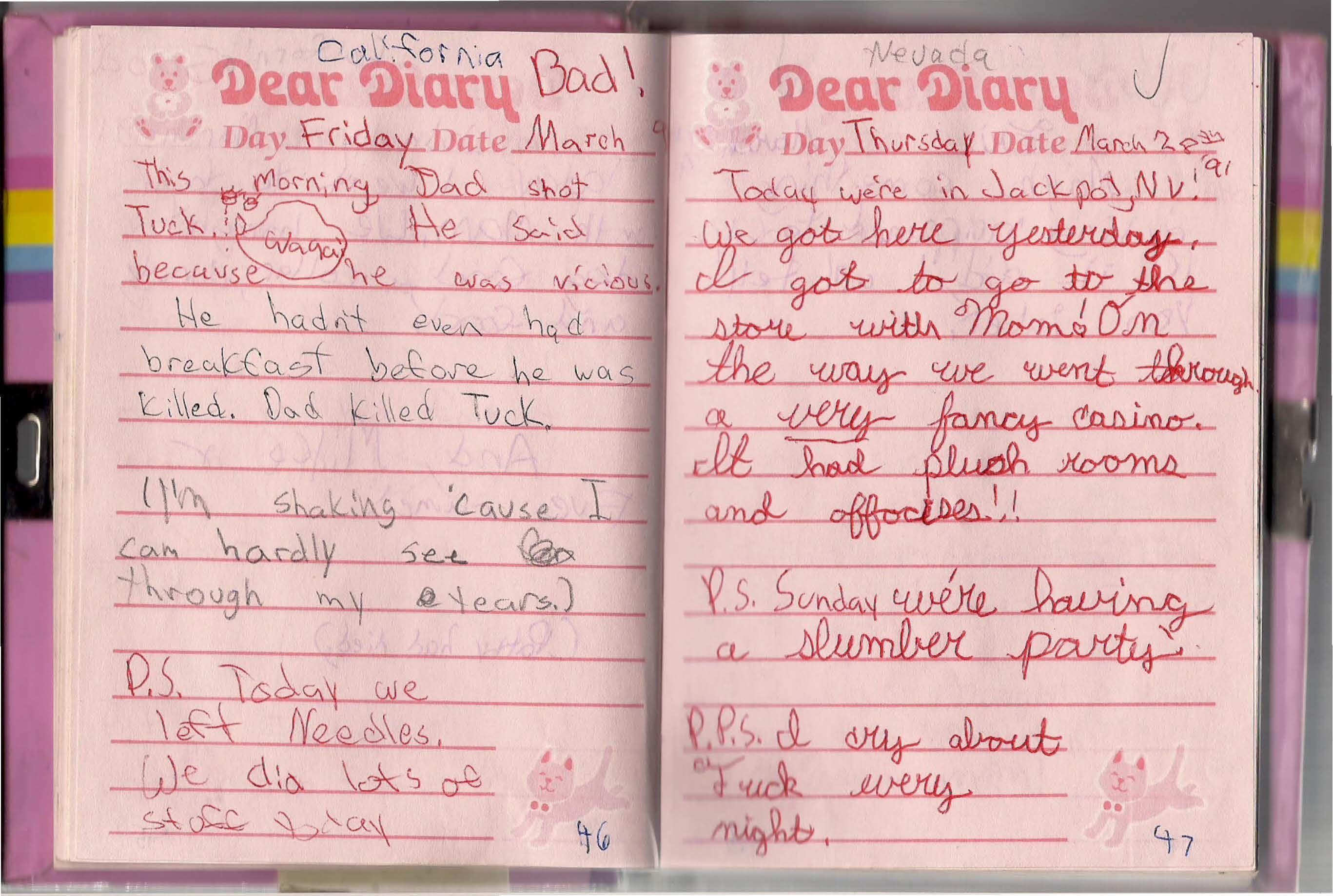
He took a whole litter of kittens, once, and he stomped on each of their tiny heads until my brothers ran sobbing away. He didn’t bother to wipe the blood from the bottom of his boots. He always had a good reason, and this time it was that we couldn’t feed them all. “If that cat gets knocked up again the same thing is going to happen,” he said. He would laugh when he told people the story of how he got a free goat, a pet goat that the owners wanted a good home for, and he said he walked into the yard and he cut that goats’ throat in front of them all and watched the blood and the horror flow all around him. “But we needed the meat, you know,” he would say, as if that made the brutality justifiable. “They didn’t see that one coming, huh? Bet those kids had never seen anything like that shit.” I bet they hadn’t. I never doubted the story.
He brought home a puppy, in a moment of thinking of us, he said, and we all fell promptly in love with the little pitbull mix. A few weeks later he ripped up a bicycle seat, and when my dad beat him mercilessly and the puppy growled at him in pain and fear, he shot it in the head with his .45. Thinking of us, again. The blast rang in my head, over and over, a death knell, and I let go of the feelings I had for the puppy. “Don’t go out there,” Mom said, perfectly still. The puppy’s yelping had stopped with the sound of the gunshot, instantly. “He was no good, he would have been a killer,” Dad said. “If they growl at you like that you can tell.”
I cry more now than I ever did as a child. When an emotion comes I try to embrace it, to let it be. The feelings weren’t easy to read on my face when I was a child. I took care to hide them and all signs of weakness, because life was hard and it would eat you up and spit you out if you showed you were weak enough to allow it. As a protective measure, I could shut it all out behind a big, smooth wall that stretched farther than I could see. I would withdraw, and I would forget for the moment until I had space to think about the things that hurt.
I am surrounded by love now, and permission to be, and gentleness, and kindness. Those things flood your heart, and make you weaker so you succumb to the tears and the feelings. I know that dad tried to make us hard, and it worked. We were all as hard as kids could be, our faces locked into masks and our feet thick as leather from running on stones. I hope that my siblings meet someone that can break that wall down for them, that they have not let the wall become them. Feeling the world hurts, yeah it does, but that’s what it takes to live. You can’t run and hide forever. I mean, you can, but at the end what do you offer to eternity – do you hold in your two hands the broken pieces of your heart? That’s what my dad will hold, and I hope he has regrets. I plan to hold my whole heart with all its scars, and to look back with love and thankfulness and joy. It all does matter, I know it does. Every kindness, every beautiful moment.
 Roads on Her Face